What Lenders Count as Income When You Work for Yourself
Published

Every guide on self-employed lending gives you the same document checklist. Almost none tells you what the numbers on those documents are worth. Two figures decide the outcome: how much of your deductions the lender puts back into your income, and whether it averages your two years or takes the worse one.
Taxable income is not assessable income
The gap between the two is the point of the whole exercise. Your accountant works to reduce taxable income; a lender works out what cash the business generates. It does that by adding back deductions that were not real outflows, commonly depreciation, amortisation of goodwill, interest on business loans, one-off extraordinary expenses, and voluntary superannuation contributions above the compulsory Super Guarantee.
Which of those a lender accepts is set by each lender's own policy rather than by legislation, so the same tax return assessed by two institutions on the same day can produce two different incomes. That is the real reason lender choice matters on a self-employed file, more than the headline rate.
On a $95,000 taxable income, assessed at 9 per cent under APRA's three point buffer over a 30-year term. The buffer itself, and the separate six-times-income ceiling, are covered in borrowing power after the RBA's August hold:
| Add-backs | Assessable income | Maximum loan | Gain |
|---|---|---|---|
| none | $95,000 | $295,169 | — |
| $8,000 | $103,000 | $320,026 | $24,856 |
| $15,000 | $110,000 | $341,775 | $46,606 |
| $25,000 | $120,000 | $372,846 | $77,676 |
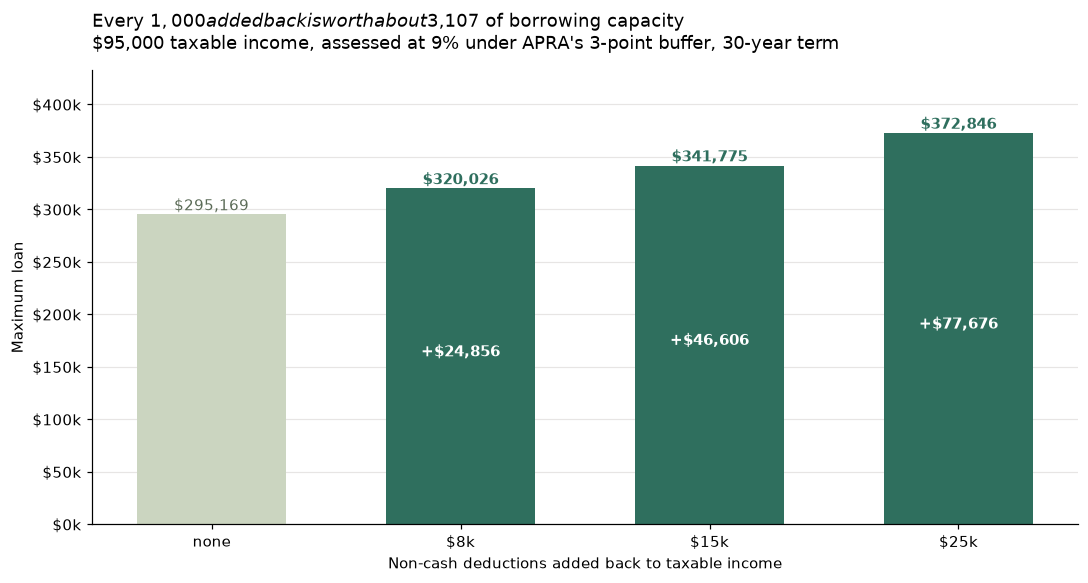
Reduced to a single ratio, each $1,000 added back is worth about $3,107 of borrowing capacity. That is why brokers build the add-back schedule with an accountant before approaching a lender rather than after. Lenders do not accept every deduction, so the schedule is a negotiation rather than a formula.
Averaged, or the worse of the two years
Lenders reviewing two years of returns either average them or take the lower year as the lower figure. Which convention applies is lender policy, and on a business whose second year dipped the difference is not small.
| Year 1 | Year 2 | Averaged | Lower year | Difference in capacity |
|---|---|---|---|---|
| $110,000 | $90,000 | $310,705 | $279,634 | $31,070 |
| $120,000 | $84,000 | $316,919 | $260,992 | $55,927 |
| $100,000 | $95,000 | $302,937 | $295,169 | $7,768 |
A 30 per cent dip in the second year costs about $55,900 of borrowing capacity if the lender takes the lower figure. The practical consequence is that a declining trend is worth explaining in writing, with evidence of recovery, rather than leaving the assessor to draw their own conclusion from two numbers.
The two-year rule has softened
The familiar line is that banks want two years of lodged returns. That has been changing. Westpac announced a one-year income assessment option in July 2025, describing it as halving the documentation required, and coverage of that announcement noted it was following Commonwealth Bank, which already accepted a single year. ANZ and NAB are widely reported to have moved earlier in the same cycle, though those dates come from broker commentary rather than the banks' own releases, so confirm current policy with the lender or a broker.
Conditions differ, but the common ones are an LVR at or below 80 per cent, a return that has been lodged and assessed, and around two years of ABN registration. The scale of the shift is visible in official data: according to the ABS Labour Account, labour income from self-employment rose 5.5 per cent to $29.5 billion in the March 2025 quarter, which is the demand the banks are responding to.
Note what the concession covers. It relaxes the financial evidence, not the trading history, so most bank policies still want the ABN, and usually GST registration, in place for about two years. GST registration itself is generally required once turnover passes $75,000.
What alt-doc costs
Where returns are not available or do not reflect current trading, alt-doc products assess income from Business Activity Statements and business bank statements with an accountant's declaration. The trade is a tighter LVR cap, commonly 70 to 80 per cent, and a higher rate.
| Route | LVR cap | Loan on $800,000 | Deposit needed |
|---|---|---|---|
| Full-doc | 80% | $640,000 | $160,000 |
| Alt-doc | 70% | $560,000 | $240,000 |
The tighter cap asks for $80,000 more deposit on the same property. The common sequence is to settle on alt-doc and refinance to full-doc pricing once a second return is lodged, which is usually 12 to 24 months later.
The cap most self-employed borrowers have not heard of
Since 1 February 2026, APRA limits banks to writing no more than 20 per cent of new mortgage lending at a debt-to-income ratio of six times or above, measured separately for owner-occupier and investor books. On $120,000 of assessable income that puts a six times ceiling at $720,000.
The detail that matters here: non-bank lenders are exempt from that limit. For a borrower already carrying business or investment debt, that exemption can decide which lenders are worth approaching at all, and it is a reason brokers reach past the majors on complex self-employed files.
What to do before you apply
Lodge the return and wait for the notice of assessment, because a return sitting in an accountant's drafts folder is the most common avoidable delay. Build the add-back schedule with your accountant first. Check that your ABN and GST registration dates support the trading history you are claiming. Clear or formalise any ATO debt. Then run your assessable figure, not your taxable one, through the borrowing power calculator.
A note on the figures
Maximum loans are the present value of a monthly amount over a 30-year term at an assessment rate of 9 per cent, being a 6 per cent loan rate plus APRA's three percentage point buffer. The monthly amount is 30 per cent of assessable income, chosen to show the mechanism rather than to model any lender. Real assessments apply the lender's own expense benchmark and treat income types differently, so treat these as the shape of the effect. The DTI limit and the buffer are APRA's published rules. The Westpac one-year option comes from its own July 2025 media release, while the other banks' timing is from broker reporting rather than primary announcements. The self-employment income figure is the ABS Labour Account for the March 2025 quarter, and the $75,000 GST threshold is the ATO's.