FHSA Contribution Room and the Cost of Waiting
Published

The FHSA limits are straightforward: $8,000 a year and $40,000 in total, tax deductible going in and tax free coming out. What decides how much of that is available to use is when the room starts to accrue, and that date is set by when the account was opened. The arithmetic below works through what opening one later costs.
Contribution room accrues from the calendar year the first FHSA is opened. Not from age 18, the way a TFSA does. An unopened account accrues nothing, and later contributions cannot recover the missed years.
What the room does
The CRA calls the limit participation room. In the year the first account is opened it is $8,000. In each later year it is the lesser of two things: $8,000 plus anything carried forward, or $40,000 less everything already contributed. Unused room does carry forward, but only $8,000 of it, so the most that can ever be available in one year is $16,000.
Two details are easy to miss. Room covers contributions and transfers from an RRSP combined, so moving $7,500 across from an RRSP leaves $500 of room for that year, and the transfer is not deductible a second time. And the room is per person, not per account: opening FHSAs at three banks gives three accounts and the same $8,000.
The most that can be contributed, by year
Because room arrives at $8,000 a year and cannot be accelerated, the ceiling on total contributions is $8,000 times the number of calendar years since the account was opened, until the $40,000 lifetime limit binds.
| Calendar year since opening | Most that can have been contributed | Still short of $40,000 |
|---|---|---|
| Year 1 | $8,000 | $32,000 |
| Year 2 | $16,000 | $24,000 |
| Year 3 | $24,000 | $16,000 |
| Year 4 | $32,000 | $8,000 |
| Year 5 | $40,000 | nil |
The table above reads as a deadline more than a schedule. Using the full $40,000 needs the account to have been open for five calendar years by the time of purchase. Opened four years before a purchase, the ceiling is $32,000; three years before, $24,000. That difference is not recoverable later.
Why carry-forward does not rescue a late start
The carry-forward rule reads like a safety net, and it is the reason people feel comfortable waiting. It is capped at $8,000, which means it can move one year's room forward and no more.
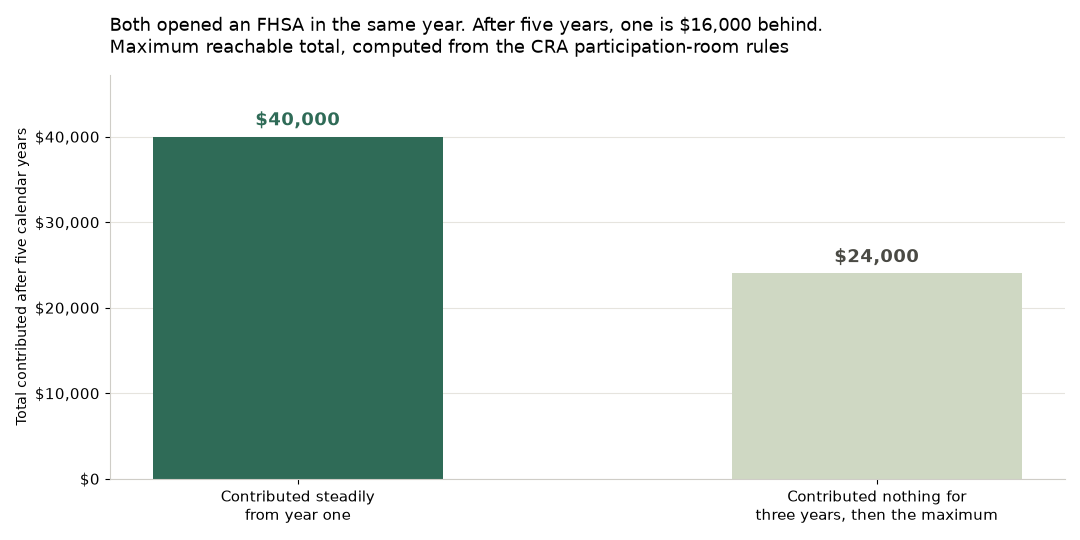
Take someone who opens an account, contributes nothing for three years, then decides to put in the maximum every year from year four. Their room in year four is $16,000, the highest it can ever be. They contribute it. In year five their room is back to $8,000, so they contribute that. After five years they hold $24,000, against $40,000 for someone who opened at the same time and contributed steadily.
| Year | Room available | Contributed | Running total |
|---|---|---|---|
| 1 | $8,000 | nil | nil |
| 2 | $16,000 | nil | nil |
| 3 | $16,000 | nil | nil |
| 4 | $16,000 | $16,000 | $16,000 |
| 5 | $8,000 | $8,000 | $24,000 |
The gap is $16,000, and no year in that table offers more than $16,000 of room. Waiting to contribute is survivable. Waiting to open is the part that costs, because the clock the room runs on only starts once.
The deduction is worth something every year, not once
An FHSA contribution reduces taxable income the way an RRSP contribution does, so the value of the deduction depends on the contributor's marginal rate. At a marginal rate of 30 per cent, an $8,000 contribution reduces tax by $2,400, and the full $40,000 by $12,000 across however many years it is spread over. At 40 per cent those become $3,200 and $16,000.
The rates above are stated inputs chosen to show the mechanism, not a claim about any province's brackets. The figure that applies is the combined federal and provincial marginal rate, and a year of lower income is a year in which the deduction is worth less. A contribution can also be held back and deducted in a later year, which matters where income is about to rise.
How it stacks with the Home Buyers' Plan
The FHSA does not replace the RRSP Home Buyers' Plan. The CRA permits a qualifying FHSA withdrawal and an HBP withdrawal for the same home, where the conditions for each are met. That is $40,000 from the FHSA and $60,000 from the HBP, which is $100,000 for one first-time buyer and $200,000 for two.
The HBP limit rose from $35,000 to $60,000 in April 2024. One guide dated March 2026 still states the limit as $35,000 and gives the combined total as $75,000. On the current limit the combined total is $100,000. A page quoting $35,000 was written against the pre-2024 rules, whatever its date says.
The two are not equivalent, though. HBP money is a withdrawal that has to be repaid to the RRSP over 15 years, starting the second year after it is taken, and a missed repayment is added to that year's taxable income. FHSA money carries no repayment.
What $100,000 is, as a down payment
Two thresholds fall out of the arithmetic. A single buyer's $100,000 is exactly 20 per cent of a $500,000 home, and a couple's $200,000 is exactly 20 per cent of a $1,000,000 home. Twenty per cent is the point at which mortgage default insurance stops being required, so at those prices the registered accounts alone clear it.
| Purchase price | $100,000 is | $200,000 is | Minimum down payment |
|---|---|---|---|
| $400,000 | 25.0% | 50.0% | $20,000 |
| $500,000 | 20.0% | 40.0% | $25,000 |
| $600,000 | 16.7% | 33.3% | $35,000 |
| $800,000 | 12.5% | 25.0% | $55,000 |
| $1,000,000 | 10.0% | 20.0% | $75,000 |
The last column is the statutory minimum: 5 per cent of the first $500,000 and 10 per cent of the portion above it. On a $600,000 home that minimum is $35,000, which a maxed FHSA on its own exceeds. Above the minimum, what changes is the default insurance premium, which falls as the down payment rises and disappears at 20 per cent. Our CMHC insurance calculator prices each band, and the premium bands are set out here.
The 15-year window starts at opening too
The participation period ends on 31 December of the earliest of three dates: the fifteenth anniversary of opening the first FHSA, the year the holder turns 71, or the year after the first qualifying withdrawal. The CRA's own example makes the first one concrete. Someone who opens in August 2025 and does not contribute until 2028 still has a window that closes on 31 December 2040, because it was the opening that started it.
Fifteen years is long enough that this rarely binds on a first purchase. It does mean opening early is not costless in both directions: an account opened at 25 has to be used, transferred to an RRSP or closed by the year the holder turns 40.
If buying is still a few years away
This is the part worth knowing early, because it is the one thing that gets harder to fix as time passes. An FHSA can be opened without contributing anything at all, and the $8,000 of room for that calendar year still accrues. Because room is measured in calendar years rather than twelve-month periods, an account opened in late December earns a full year's room from a few days of existence, and one opened in early January has just missed a year.
Almost everything else stays flexible. Providers can be changed, years can pass with no contributions at all, and if the purchase never happens the balance can move to an RRSP without using RRSP room. The opening date is the one detail that cannot be revisited, which seems worth saying while it is still ahead of you rather than behind.
Methodology
Every figure here is computed from the participation-room rules the CRA publishes, not quoted from another publisher. The model is checked against four of the CRA's own worked examples before any figure in this article is used. A holder who opens an account and contributes nothing has $16,000 of room the following year. A holder who contributes $6,000 carries $2,000 forward. An account opened in August 2025 has a window ending 31 December 2040. And a holder who opens at 60 sees the window close in the year they turn 71. The model reproduces all four.
The down payment table applies the statutory minimum of 5 per cent on the first $500,000 and 10 per cent above it. The marginal tax rates in the deduction section are stated inputs rather than any province's actual brackets. Contribution figures assume no excess contributions, no taxable withdrawals and no re-participation room, which is the ordinary case; the CRA's definitions page covers the rest. Rules confirmed against the CRA pages listed below, which were last revised on 2 February 2026.