Canada's 2026 Renewal Wave: How Big Is the Payment Jump?
Published

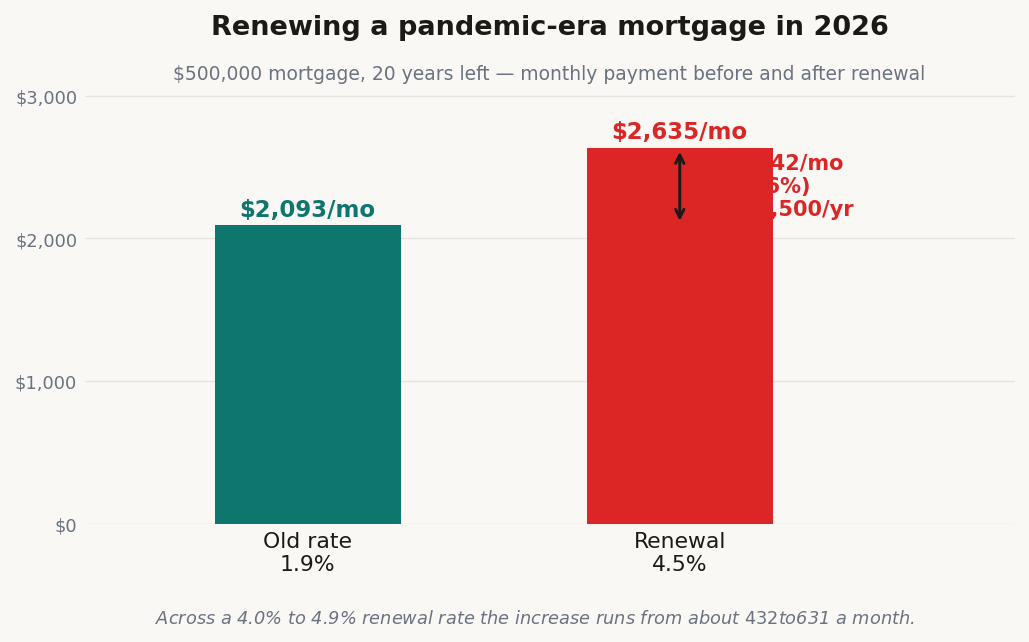
A Canadian mortgage renewal in 2026 is, for many households, the moment a pandemic-era rate near 2% resets into the mid-4% range. The monthly payment jumps with it. On a $500,000 mortgage taken at 1.9%, a payment of about $2,093 climbs to roughly $2,635 when it renews at 4.5% with 20 years left. That is an increase of about $542 a month, or close to $6,500 a year. The Bank of Canada is holding its policy rate at 2.25%, and roughly 60% of all mortgages renew across 2025 and 2026. That has made this renewal wave the biggest household-budget story in Canadian housing. How hard it hits you depends on your new rate, your balance, and the amortization you have left.
Why is renewal such a shock in 2026?
Between 2020 and 2022 the Bank of Canada cut its policy rate to near zero to steady the economy. Lenders passed on five-year fixed rates as low as 1.4% to 2%. Those five-year terms are now expiring into a very different market, with fixed rates tied to higher government bond yields and sitting around 4% to 4.9%. Roughly 60% of all outstanding mortgages renew across 2025 and 2026, and most of the pandemic borrowers chose five-year fixed, so more than a million households are meeting that gap at once. The policy rate itself has settled back to 2.25%. But fixed rates take their cue from bond yields rather than the overnight rate, so they have stayed high.
How much will your payment go up?
Take the $500,000 example renewing with 20 years of amortization left. At the old 1.9% rate the payment was about $2,093 a month. Renewing at 4.5% lifts it to roughly $2,635, a rise of about $542 a month that adds up to some $6,500 over a year. Move the renewal rate across the range on offer and the jump runs from about $432 a month at 4.0% to about $631 a month at 4.9%. The Bank of Canada puts the average increase for five-year fixed renewers in 2025 and 2026 near 15% to 20%. You can price your own balance and rate in the mortgage calculator.
Does everyone face a bigger payment?
No, and this is the part the headlines tend to miss. The sharp increases land on five-year fixed holders who locked in near the bottom. Borrowers with variable-rate, fixed-payment mortgages may even see a small decrease of around 5% to 7% as the policy rate eases from its peak. People who took shorter terms during the 2023 rate-hiking cycle can even renew lower. Because the gains and losses offset, the median change across all Canadian borrowers sits close to zero. The strain is concentrated on one group rather than spread evenly.
How to soften the renewal jump
The renewal letter your lender sends is rarely its best rate, so shop around or have a broker do it. Even a small rate improvement is worth hundreds of dollars a year on a large balance. Making a prepayment before you renew shrinks the balance that gets re-priced, which you can test in the prepayment calculator. Extending the amortization lowers the monthly payment, though it raises the total interest you pay, so treat it as breathing room rather than a free lunch. Weigh a fixed against a variable renewal in the fixed vs variable calculator before you sign.
Fixed or variable at renewal?
A fixed renewal near 4% to 4.6% locks your payment and removes the guesswork, which suits anyone whose budget has little room for surprises. A variable renewal tracks the prime rate, currently around 4.45%. It mainly rewards you if the Bank of Canada starts cutting, which most forecasters expect to be modest through 2026. With the central bank widely seen as at or near the bottom of its cycle, the choice comes down to how much certainty you want rather than a confident bet on cheaper money soon. If the renewal falls below 20 per cent equity, default insurance is part of the picture too, and the CMHC premium bands set out what it costs.
A note on the figures
The example uses a $500,000 mortgage originally at 1.9% over a 25-year amortization, renewing after the five-year term with 20 years left, priced with the semi-annual compounding Canadian fixed mortgages use. Renewal rates of 4.0% to 4.9% reflect the market in mid-2026, with the Bank of Canada policy rate at 2.25%. Your own figures depend on your balance, rate, and amortization, so see the Bank of Canada analysis and confirm with your lender or a licensed broker.