How Much You Can Borrow: Ireland's Central Bank Mortgage Rules
Published 28 July 2026
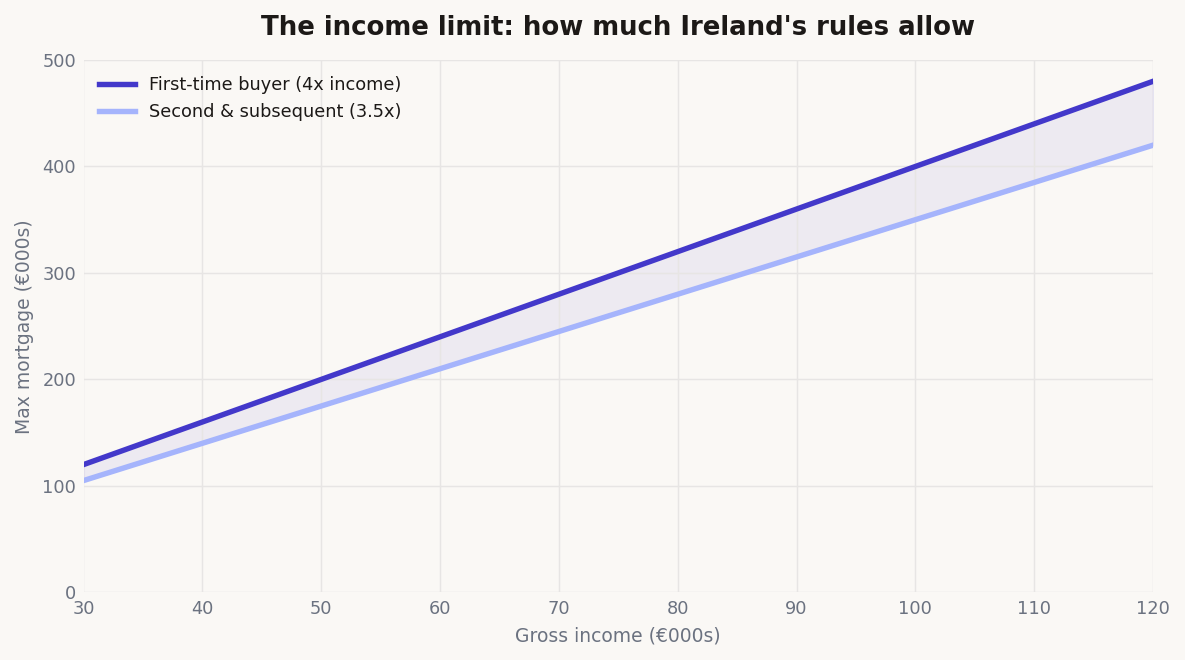
Two Central Bank of Ireland rules decide the size of almost every Irish mortgage. The income rule caps your loan at four times gross income if you are a first-time buyer, or 3.5 times if you have owned a home before. The deposit rule caps the loan at 90% of the price, so you need at least a 10% deposit. Whichever of the two produces the smaller loan is the one that limits you.
The income rule: loan-to-income
The loan-to-income (LTI) limit measures the mortgage against your gross, pre-tax income. First-time buyers can borrow up to four times income; second and subsequent buyers up to 3.5 times. The first-time-buyer multiple was raised from 3.5 to four times in January 2023. For a joint application the limit applies to the combined income of both applicants.
Worked through on a few incomes:
- A single first-time buyer earning €60,000 can borrow up to €240,000 (4 × €60,000).
- Two first-time buyers earning €50,000 each have €100,000 combined, so up to €400,000 (4 × €100,000).
- A second-time buyer earning €50,000 can borrow up to €175,000 (3.5 × €50,000).
The multiple applies to the loan, not the purchase price. A higher deposit does not lift the income ceiling; it only reduces how much of a given price you need to borrow.
The deposit rule: loan-to-value
The loan-to-value (LTV) limit measures the mortgage against the property price. First-time buyers and second or subsequent buyers can both borrow up to 90% of the price, so the minimum deposit is 10%. Before January 2023, second and subsequent buyers needed 20%. Buy-to-let borrowers are held to a lower 70% limit, meaning a 30% deposit. On a €400,000 home at the 90% limit, that is a €40,000 deposit and a €360,000 loan.
Which rule sets your limit?
Both rules apply at once, and the tighter one wins. Take a couple earning €90,000 between them, both first-time buyers: the income rule allows up to €360,000 (4 × €90,000). To buy a €400,000 home they also need to clear the deposit rule, which on that price means €40,000 down and a €360,000 loan. Here the two rules agree.
Push the price up to €420,000 and they diverge. The income rule still caps the loan at €360,000, so the deposit has to rise to €60,000, roughly 14% of the price, well above the 10% minimum. The income rule, not the deposit rule, is what forces the larger deposit. You can see this interplay directly in the Ireland affordability calculator and the loan-to-value calculator.
Can a lender lend more? The exceptions
The limits are not absolute. Each year a lender may exceed them on a share of its new lending, currently up to about 15% of first-time-buyer loans and a similar share of second and subsequent buyer loans. These allowances tend to be used up early in the year, and an exception is granted at the lender's discretion for a stronger application, not claimed as a right. Plan around the standard limits, and treat an exception as a possible bonus rather than the basis of your budget.
Do the rules apply if I am switching?
If you are moving an existing mortgage to a new lender for a better rate, a straight switch of the outstanding balance on the same home is exempt from the income rule. The new lender still runs its own affordability check, but the four-times ceiling does not block a like-for-like switch. Our mortgage switcher calculator works through what a move could save.
A note on accuracy
The figures here are the standard Central Bank limits for owner-occupier lending in 2026. Individual lenders interpret eligible income differently, particularly where pay includes bonuses or overtime, and the exception allowances shift the picture at the margin. For the source rules see the Central Bank of Ireland mortgage measures and Citizens Information, and confirm your own position with a regulated mortgage broker.