Choosing an Irish Mortgage Rate: Fixed, Variable, or Tracker
Published 28 July 2026
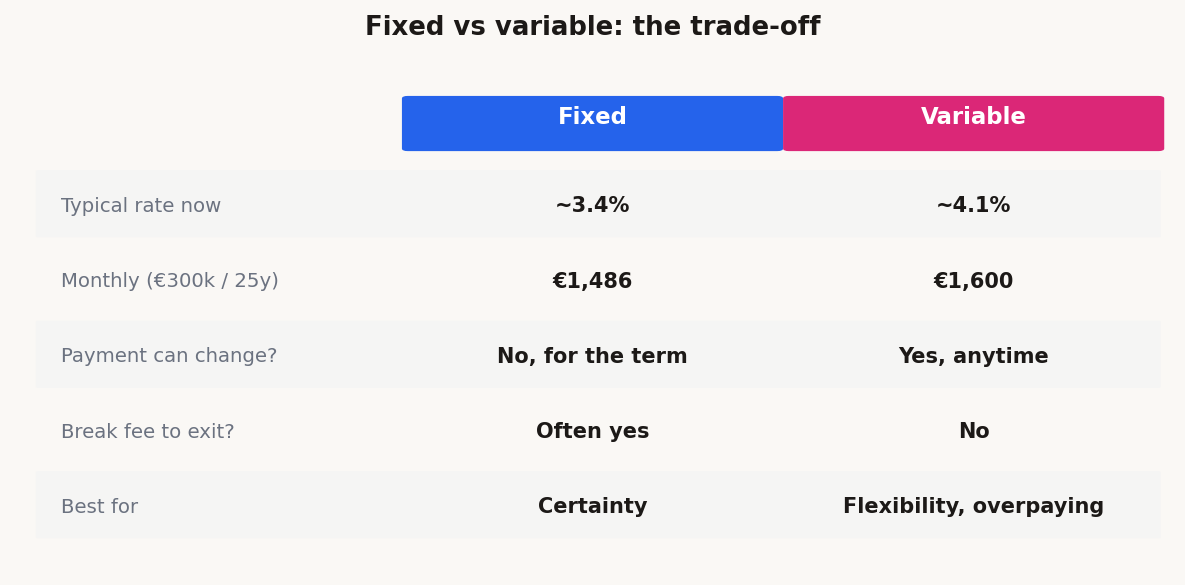
If you are taking out a new mortgage in Ireland, the real choice is between a fixed rate and a variable rate. A fixed rate locks your repayment for a set term; a variable rate can change at any time. Tracker mortgages, which follow the European Central Bank rate directly, come up often but have been closed to new customers since 2008, so only existing holders still have one. In 2026 fixed rates are both the more popular choice and, unusually, the cheaper one for most buyers.
Fixed rate: certainty for a set term
A fixed rate holds your interest rate, and so your repayment, steady for an agreed term, commonly one to ten years. Whatever the ECB does in the meantime, your payment does not move until the term ends. That certainty is why more than four in five new Irish mortgages are now fixed. The trade-off is flexibility: leaving a fixed rate early, or making large overpayments, can trigger a break fee. Homes with a strong Building Energy Rating often qualify for a lower green fixed rate, and the lowest fixed rates in 2026 have sat around 3.0% to 3.5%.
Variable rate: flexibility, and exposure
A standard variable rate can be changed by the lender at any time, usually with notice. It is not tied to the ECB the way a tracker is, but lenders tend to move it with the wider rate environment, so it can rise or fall during your loan. The upside is freedom: with no fixed term, you can overpay or clear the balance without a break fee. The downside is that variable rates in Ireland have sat higher than fixed ones through 2026, and your payment is exposed if rates climb.
Tracker: the one you cannot get any more
A tracker rate is the ECB rate plus a fixed margin, so it moves point for point with every ECB decision. Trackers were withdrawn from new lending after the financial crisis, and roughly 130,000 legacy holders are the only people who still have them. If you hold one at a low margin it is usually worth keeping, and a few lenders let you carry it to a new home when you move. For anyone buying now, though, a tracker is not an option on the table.
What it costs: a worked comparison
Take a €300,000 mortgage over 25 years. At a fixed 3.4% the repayment is about €1,486 a month, and it stays there for the whole fixed term. At a variable 4.1% it is about €1,600, roughly €114 a month more. If that variable rate rose half a point to 4.6% the repayment would be about €1,685; if it fell to 3.6% it would be about €1,518. As a rule of thumb, each 0.25-point move changes a variable repayment by about €39 a month per €300,000 borrowed. You can run your own pairing in the fixed-versus-variable calculator.
When each one wins
A fixed rate suits you if you value a predictable payment, rates are low when you draw down, and you do not plan to overpay heavily or move soon. A variable rate suits you if you expect to make large overpayments, clear the loan early, or move within a short window, since it sidesteps break fees, or if you have a firm view that rates will fall. When a fixed term ends, do not drift onto the lender's default variable rate by inertia: switching is usually cheaper, switchers are exempt from the Central Bank's four-times-income cap, and there is often no break fee to leave once the term is up. Our switcher calculator shows the size of the saving.
A note on accuracy
Rate levels here reflect the Irish market through 2026 and move with lender pricing and ECB policy. Your own rate depends on your loan-to-value band, your Building Energy Rating, and the lender. For the definitions see Citizens Information on mortgage types and the CCPC, and confirm live rates with a regulated mortgage broker.