Why the Same Mortgage Rate Can Produce a Different Payment
Published 25 July 2026
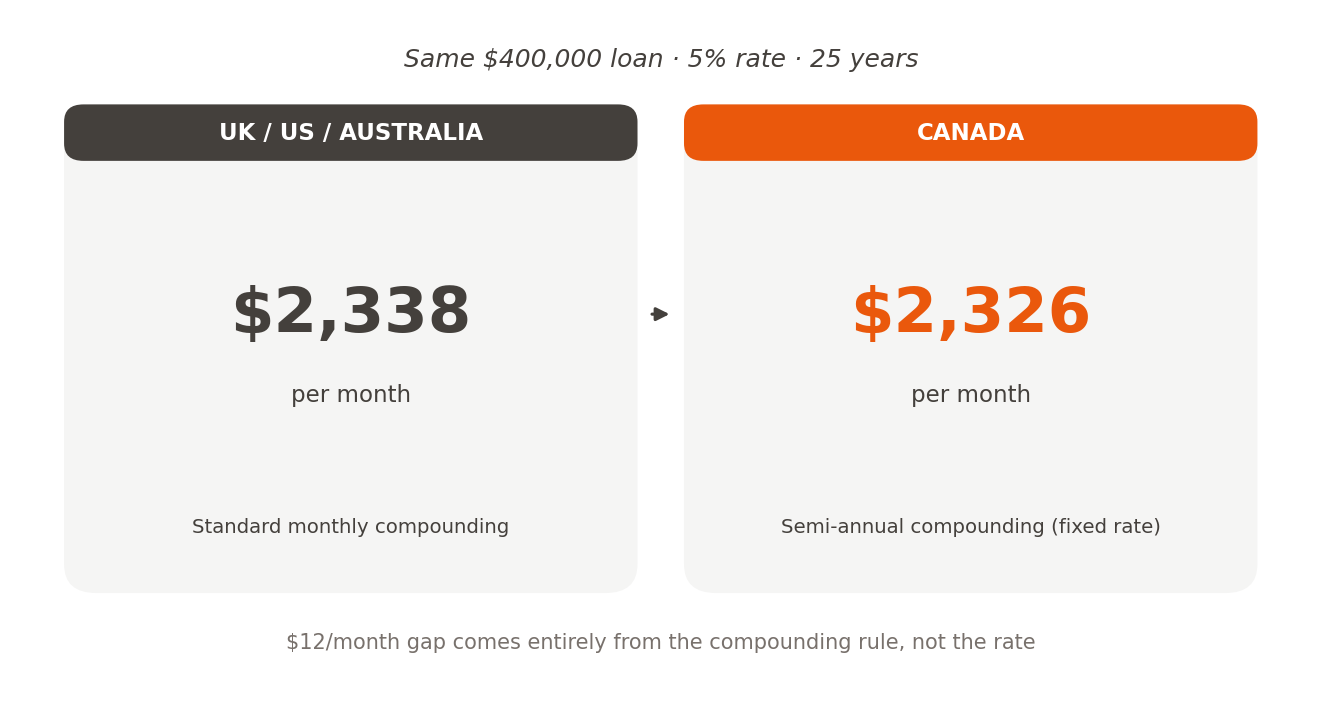
Quote a Canadian, an American, a Brit and an Australian the exact same number ("5% fixed") and hand each of them an identical $400,000 loan over 25 years, and three of them will get an identical payment. The fourth, the Canadian, will pay about $12 a month less. Same rate, same balance, same term, different result. The gap isn't a rounding error or a lender being generous. It comes down to a legal quirk in how interest compounds, and it's one of the more useful things to understand before you compare a rate you've been quoted against a rate a friend in another country mentions.
The 5% that isn't quite 5%
A quoted mortgage rate is a nominal annual rate. To turn it into a monthly payment, a lender first has to convert it into an effective monthly rate, and that conversion depends on how often interest is assumed to compound over the year.
In the UK, US and Australia, a fixed-rate mortgage is compounded monthly. The math is direct: divide the annual rate by 12, and that's your monthly rate. On 5%, that's 0.4167% a month.
Canada is the outlier, and the reason is legislative rather than commercial. Section 6 of the federal Interest Act requires that interest on a mortgage with a term over five years (and, by long-standing lender practice, on shorter fixed terms too) be expressed as if compounded semi-annually, not in advance, even though the borrower is still making monthly payments. Converting a semi-annual compounding convention into a monthly rate uses:
c = (1 + i/2)^(2/12) − 1Run 5% through that formula and you get a true effective monthly rate of about 0.4124% — slightly below the naive 0.4167%. That small difference compounds (no pun intended) over hundreds of payments into a real gap in your monthly bill.
Here's what it looks like on an actual loan: $500,000 home, $100,000 down, a $400,000 loan, 5% fixed, 25-year amortization.
- UK, US, or Australian-style monthly compounding: $2,338/month
- Canadian fixed-rate semi-annual compounding: $2,326/month
Twelve dollars a month sounds trivial until you multiply it out: over a 25-year amortization, that's roughly $3,600 less in payments for the Canadian borrower, purely from a compounding-frequency rule that has nothing to do with creditworthiness, lender margin, or risk pricing.
Why Canada's variable-rate mortgages don't get the same break
If you're shopping a Canadian mortgage and you've read this far expecting variable rates to follow the same discount, they don't. The Interest Act's semi-annual rule applies specifically to fixed-rate mortgages. In practice, lenders compound variable-rate mortgages monthly, same as the UK, US and Australia. That's actually why, on paper, a variable Canadian mortgage at the same nominal rate as a fixed one will show a marginallyhigher payment: the fixed rate gets the semi-annual compounding discount, the variable rate doesn't.
It's a strange asymmetry to explain to anyone outside Canada, and it trips up plenty of Canadians too. The rate that "sounds" identical to a fixed rate isn't identical once you do the arithmetic underneath it. If you're also trying to work out how much mortgage you'd actually qualify for in Canada, the compounding rule is only one part of the picture — see our breakdown of how GDS and TDS ratios decide your approved amount.
Why this matters beyond curiosity
If you're comparing quotes across lenders within the same country, compounding convention stays constant and won't explain why one offer beats another. But it matters in three real situations:
- You're comparing a fixed and a variable rate from the same Canadian lender. A quoted rate that looks identical between the two products isn't producing an identical payment, and now you know why.
- You're reading US, UK or Australian mortgage content while living in (or moving to) Canada(or vice versa). Generic advice and generic formulas from one market can be quietly wrong if you drop them into a Canadian calculation without adjusting the compounding basis.
- You're building or checking your own amortization schedule (in a spreadsheet, say) and the numbers won't match a Canadian lender's illustration unless you've built the semi-annual conversion into the formula.
What to remember before you compare two rates
A nominal rate only becomes a payment after it passes through a compounding rule, and that rule is not universal. Three of these four countries treat it the same way; Canada treats fixed rates differently by law. If you only remember one thing from this, remember to check which convention a calculator or lender is using before you compare a "5%" in one place to a "5%" in another — they may not be the same number at all.