Mortgage Overpayments: What Extra Money Really Buys You
Published 26 July 2026
Every extra pound, dollar, or euro you put toward a mortgage beyond the scheduled payment goes straight to principal, and because it goes to principal early, it stops accruing interest for every month that follows. That knock-on effect is why a fairly modest monthly overpayment can shave years off a mortgage, not just months, and it's worth understanding the mechanics before assuming a small amount "won't make a difference."
What happens if you double your mortgage payment?
Most people expect doubling the payment to halve the term. It does much better than that. The reason is worth understanding, because it applies to any overpayment rather than only a doubled one.
On £250,000 at 4.25% over 25 years the payment is about £1,354 a month and the interest over the full term is about £156,300. Pay £2,709 instead, twice the amount, and the mortgage clears in 9.3 years rather than 12.5, with interest of about £53,300. That is £103,000 saved and 15.7 years removed.
| Monthly payment | Term | Total interest | Interest saved |
|---|---|---|---|
| £1,354 (contractual) | 25 years | £156,304 | — |
| £1,490 (+10%) | 21.3 years | £130,180 | £26,123 |
| £2,032 (+50%) | 13.5 years | £78,923 | £77,381 |
| £2,709 (doubled) | 9.3 years | £53,271 | £103,033 |
The term falls faster than the payment rises. Every pound of overpayment removes itself from the balance, and it also removes all the future interest that pound would have generated. Early in a mortgage, almost the whole contractual payment is interest. So the extra amount attacks capital instead, and the compounding that was working against you starts working the other way.
Look at the +10% row. It is the one most people can afford. An extra £136 a month removes £26,123 of interest and 3.7 years. You do not need to double anything to get most of the benefit. The first increments work hardest.
Two cautions before doubling anything. Check your annual overpayment allowance first. On most UK fixed deals it is 10% of the outstanding balance a year, and an early repayment charge applies above that. Then keep a cash reserve you can reach. Money paid into a mortgage is hard to get back out, and a cleared mortgage does not fix a boiler.
The worked example
Take a £280,000 mortgage at 5.25%, on a standard 25-year repayment schedule:
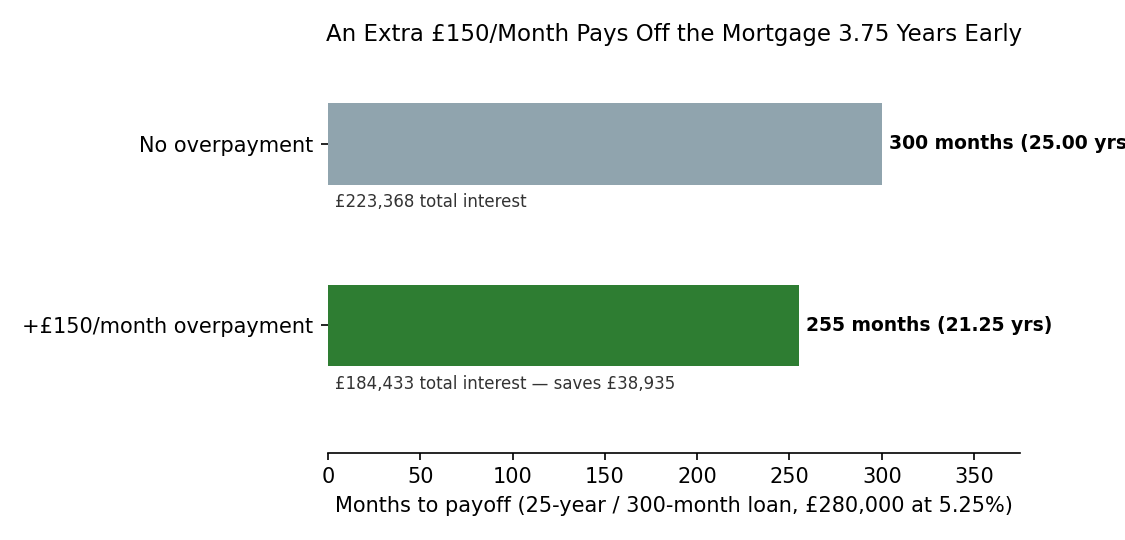
- Standard monthly payment: £1,677.89, and paid on schedule with no overpayments, the loan runs its full term, 300 months, with total interest of £223,368.
- Same loan, with an extra £150 added to every monthly payment: the loan clears in 255 months (21.25 years), a full 3.75 years early, and total interest drops to £184,433, a saving of £38,935 over the life of the loan.
That extra £150 a month is £1,800 a year, a modest amount for many households, and it still returns nearly £39,000 in saved interest plus almost four years off the mortgage term. The earlier in the loan you start overpaying, the larger the effect, because more months of avoided interest add up over a longer remaining term.
Why the timing of an overpayment matters
A £1,800 lump sum paid in month 1 saves more interest than the same £1,800 paid in month 200, because it starts reducing the balance (and therefore the interest charged on that balance) immediately, and keeps compounding for the entire remaining term. Spreading overpayments monthly rather than saving up for one large annual lump sum captures slightly more of this effect, though the difference between monthly and annual overpaying of the same total amount is usually secondary to simply starting as early as possible.
What lenders actually let you do, and where the limits are
Overpaying isn't unlimited on most fixed-rate products; each of these three markets structures the limit differently.
UK: the 10% rule. Most fixed-rate mortgages allow overpayments of up to 10% of your outstanding balance per year without triggering an Early Repayment Charge (ERC). On a £280,000 balance, that's up to £28,000 in penalty-free overpayments in that mortgage year, and the allowance is recalculated (either on the anniversary of your fixed period or on a fixed calendar date, depending on the lender) as the balance falls. Exceed the limit and the ERC is typically 1% to 5% of the amount over the allowance. Variable-rate and tracker mortgages in the UK often have no overpayment limit at all, since there's no fixed-rate deal to break.
Canada: prepayment privileges, and they don't roll over. Canadian lenders typically allow an annual lump-sum prepayment of 10% to 20% of the original principal (not the current balance), plus, with many major banks, a separate "double-up" feature that lets you double any single scheduled payment. Both privileges are generally use-it-or-lose-it on a calendar-year basis: an unused portion of this year's allowance doesn't carry forward into next year.
Australia: caps mainly apply to fixed-rate loans. Variable-rate home loans in Australia typically allow unlimited extra repayments, often paired with an offset account or redraw facility. Fixed-rate loans, by contrast, usually cap extra repayments at somewhere between $10,000 and $30,000 per year during the fixed period, with break costs potentially applying if you exceed the cap, and redraw access to your extra repayments often subject to a small per-transaction fee.
Should you overpay, or invest the difference instead?
This is the honest trade-off, and it doesn't have a universal answer. Overpaying delivers a guaranteed, risk-free return equal to your mortgage interest rate, since every pound of overpayment is a pound that stops accruing interest at that rate. Investing the same money elsewhere could return more over the long run, historically, but isn't guaranteed, and carries market risk that a mortgage overpayment simply doesn't. If your mortgage rate is relatively high, overpaying looks more attractive on a pure risk-adjusted basis; if your rate is unusually low, the case for investing instead strengthens, though it remains a personal risk tolerance decision, not a purely mathematical one.
The case for keeping some flexibility instead
Overpayments permanently reduce your mortgage balance, and on most standard mortgage products, you can't easily pull that money back out later if an emergency comes up (some lenders allow limited penalty-free overpayment reversal or offer a linked redraw facility, but many don't). Before committing large sums to overpayments, most guidance points to building an emergency fund and addressing any higher-interest debt first, since a credit card or personal loan balance at a materially higher rate than your mortgage is a better first target for extra cash.
Run the calculation on your own numbers
The general shape of these results (meaningful time and interest savings from a fairly modest monthly amount) holds across most standard mortgages, but the exact figures depend entirely on your own rate, remaining balance, and remaining term. Calculate your own break-even using your specific numbers rather than assuming the £150/month example above translates directly to your situation.