Mortgage Points: The Break-Even Math Before You Buy Down Your Rate
Published 26 July 2026
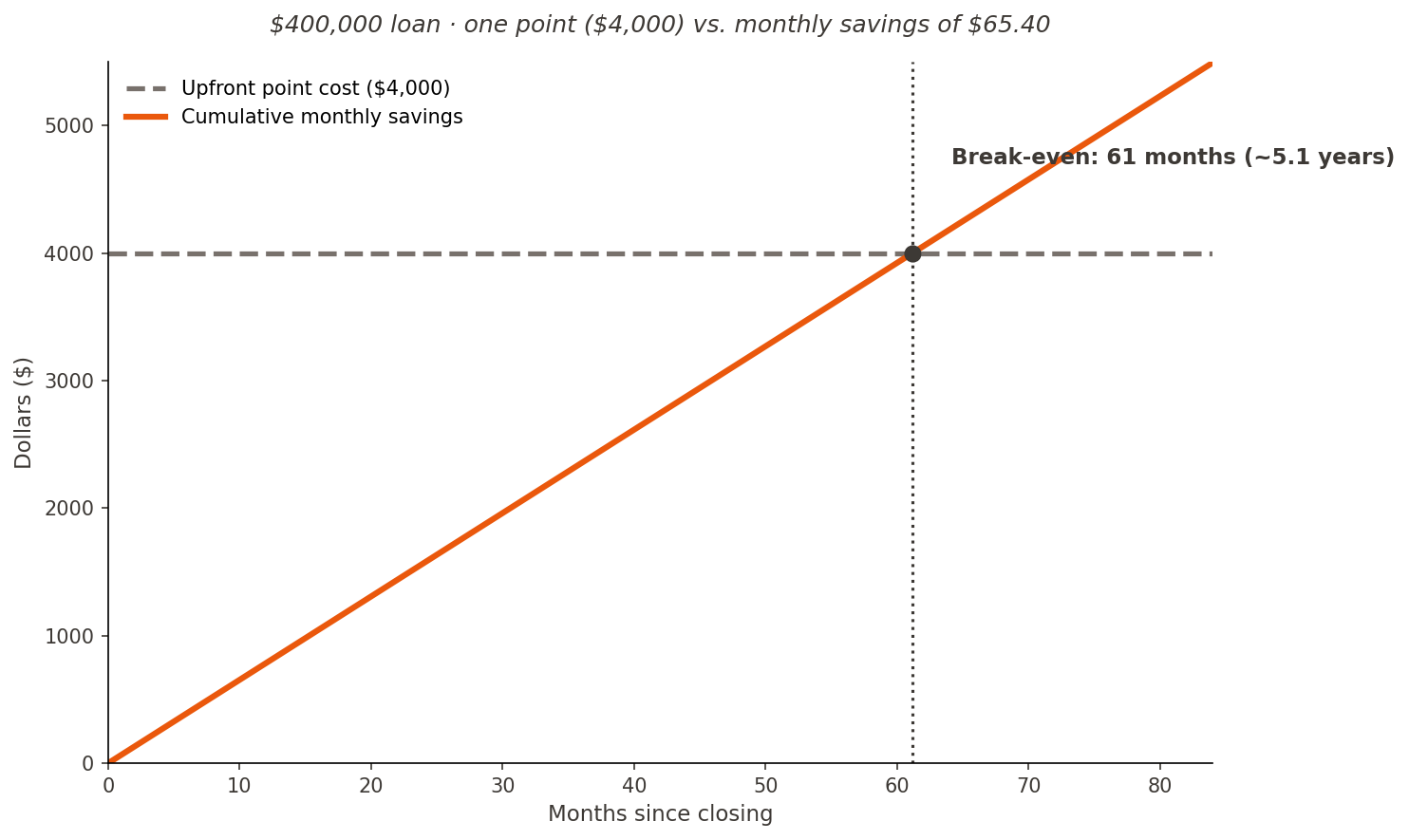
Pay $4,000 upfront, and a lender will knock a chunk off your interest rate for the life of the loan. That's the entire pitch behind mortgage points, and it usually skips the one number that actually decides whether it's a good deal for you specifically: how long you plan to keep the loan.
What a point actually is
One mortgage point (also called a discount point) costs 1% of your loan amount, paid at closing, in exchange for a lower interest rate. On a $400,000 loan, one point costs $4,000. The rate reduction per point varies by lender and loan type, but a common range is 0.125 to 0.25 percentage points off your rate for each point purchased.
Points are optional. You can take the lender's quoted rate with zero points, or pay for one, two, or occasionally more to buy the rate down further.
The worked example
Take a $400,000, 30-year fixed loan at 6.5% with no points, compared to the same loan at 6.25% after paying one point ($4,000 upfront):
- No points, 6.5%: monthly principal and interest payment of $2,528.27.
- One point, 6.25%: monthly payment drops to $2,462.87, a saving of $65.40 a month.
Divide the $4,000 upfront cost by the $65.40 monthly saving and you get the break-even point: 61 months, or just over 5 years. Before that point, you've paid more for the point than it's saved you. After it, every remaining month is money in your pocket that wouldn't otherwise be there.
What it looks like if you leave early
Sell or refinance at the 3-year mark, and the math flips: 36 months of savings at $65.40 comes to $2,354.40, against a $4,000 upfront cost. That's a net loss of $1,645.60, money spent on a rate reduction you didn't hold long enough to recover.
Stay for the full 30 years instead, and the picture is very different. Total interest paid over the life of the loan comes to about $510,178 at 6.5% with no points, versus about $490,633 at 6.25% including the $4,000 point cost, a lifetime saving of roughly $19,545.
The one question that decides it
Every other factor in the mortgage points decision (rate, loan size, lender-specific pricing) is secondary to a single question: how long do you realistically expect to keep this loan? Average tenure varies widely, but a meaningful share of homeowners move, refinance, or sell within 5 to 7 years of taking out a mortgage, which sits right around where break-even typically lands on a moderate one-point buydown.
If you have a specific reason to expect a shorter stay (a job that tends to relocate you, a starter home you plan to outgrow, a rate environment where refinancing looks likely), that shortens your effective holding period and pushes the decision toward skipping points. If you're buying what you consider a genuinely long-term home and have the cash available without straining your down payment or reserves, points can be a reasonable way to lock in a lower payment for good.
Points aren't your only use for that cash
The $4,000 spent on a point is money that could instead go toward a larger down payment, a rate buydown through a different mechanism (like a seller-paid temporary buydown), or simply staying in your pocket as a reserve. A larger down payment reduces your loan amount directly and may also help you avoid or reduce mortgage insurance, which changes the comparison. Run the numbers on your specific alternative use of that cash before assuming a point is automatically the better place for it.
Tax treatment, briefly
Points paid on a loan to purchase your primary residence are generally fully deductible in the year you pay them, provided the loan is secured by your main home and the points are calculated as a percentage of the loan amount, among a few other IRS conditions. Points paid on a refinance typically have to be deducted gradually over the life of the loan instead of all at once. This is a meaningful factor for some borrowers, but it's a secondary consideration; the break-even math above should be the first filter, not the tax treatment.
Know your break-even before you sign
A mortgage point is a trade of cash today for a lower payment over time, and whether that trade is worth it comes down almost entirely to how long you'll hold the loan. Ask your lender for the exact rate-per-point they're offering, calculate your own break-even month using your specific numbers, and be honest with yourself about your realistic timeline in the home before deciding.