How Lenders Decide How Much You Can Borrow
Published 25 July 2026
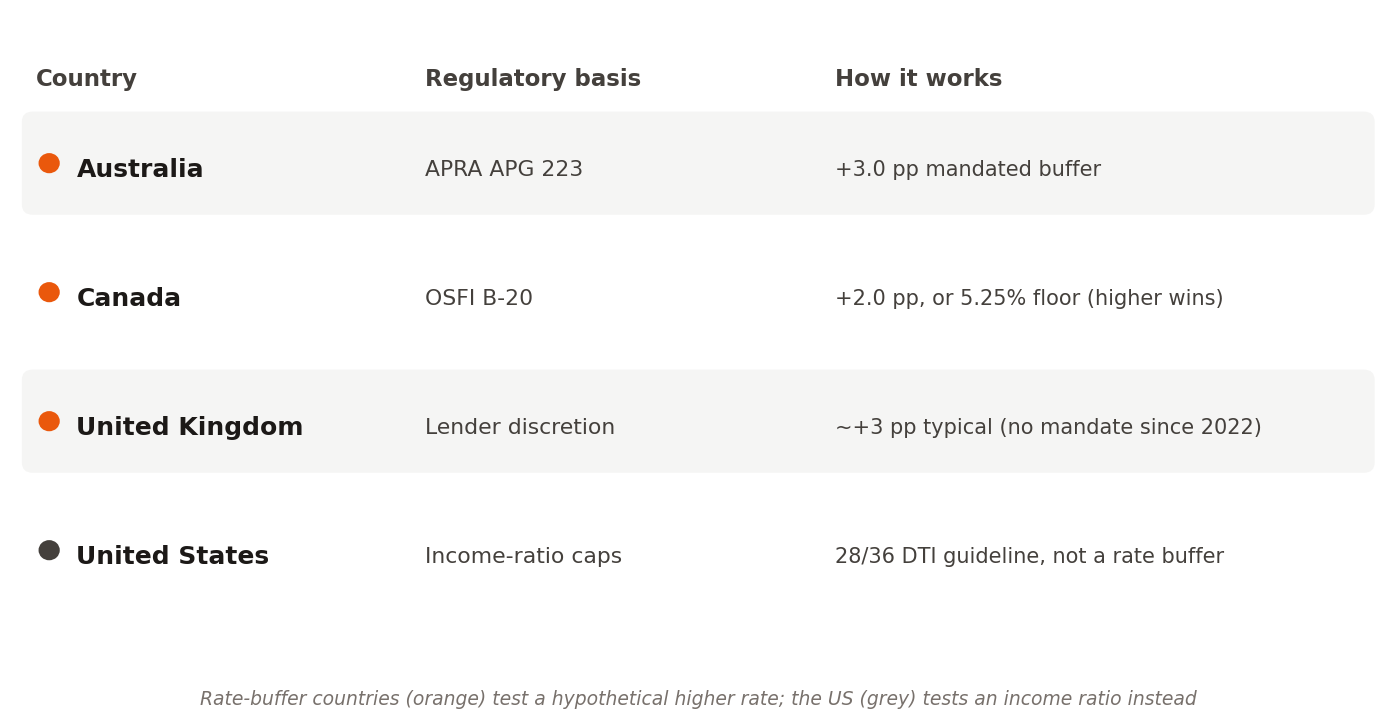
Ask a lender in four different countries the same question ("can this person afford this mortgage?") and you'll get four different testing methods, even though they're all trying to answer a version of the same underlying worry: what happens if rates rise, or income falls, after the loan is approved. Three of these four countries answer that worry by testing the applicant against a rate higher than the one they're actually being offered. The fourth answers it with income-ratio limits instead. Knowing which kind of test applies to you changes what actually gets you approved.
The rate-buffer countries: Canada, Australia and (informally) the UK
Canada has the most explicit, rules-based version. Under the federal banking regulator OSFI's Guideline B-20, federally regulated lenders must qualify a mortgage applicant at the higher of the contract rate plus 2 percentage points, or a floor rate of 5.25%, whichever is higher. This is the "minimum qualifying rate" (MQR), and it applies whether the mortgage itself is fixed or variable. A borrower being offered 5% gets tested at 7% (5% + 2), not 5%, because 7% is higher than the 5.25% floor.
Australia runs a similar concept with a different number. APRA's Prudential Practice Guide APG 223 directs authorized deposit-taking institutions to apply a serviceability buffer of at least 3.0 percentage points above the contract rate when assessing a borrower's ability to repay. That buffer was raised from 2.5 points to 3.0 in October 2021, specifically in response to a fast-rising property market, a reminder that these buffers aren't fixed forever; regulators adjust them.
The UK used to have a directly comparable rule, though measured against a different base rate: the Bank of England recommended lenders stress-test applicants against a rate 3 percentage points above the lender's own reversion (SVR) rate, not the contract rate itself, which made the old test considerably tougher than a simple "+3 on the quoted rate" (since the SVR is already well above most contract rates; see our article on the UK's fixed-rate cliff). That recommendation was withdrawn in August 2022. UK lenders still stress-test affordability under FCA rules (MCOB 11.6), but the specific margin, and the base it's measured against, is now set at each lender's own discretion, which is why UK stress rates you'll see quoted vary, typically landing somewhere in the 7.0%-8.5% range in 2026 even when contract rates sit around 4.5%-5%.
The US: a different kind of test entirely
The US doesn't test applicants against a hypothetical higher rate at all: for a fixed-rate mortgage, the rate you're approved at is the rate you're tested at. Instead, US underwriting leans on debt-to-income (DTI) ratio ceilings.
The traditional guideline is the 28/36 rule: housing costs (principal, interest, taxes, insurance, sometimes called PITI) shouldn't exceed 28% of gross monthly income, and total debt payments (housing plus car loans, student loans, credit cards, and so on) shouldn't exceed 36%. In practice, actual approvals are considerably more flexible than that guideline suggests. FHA loans commonly approve back-end DTI ratios in the 43% range, and with a strong automated-underwriting result (compensating factors like a high credit score, cash reserves, or a large down payment), some conventional and FHA loans can be approved with back-end DTI as high as 50%.
The key structural difference: a US applicant with a fixed-rate mortgage is being asked "does your current income comfortably cover this payment relative to your other debts," not "could you afford this if rates were 3 points higher." An adjustable-rate mortgage (ARM) applicant, by contrast, typically is qualified with some allowance for the rate's potential to reset, since the rate itself isn't fixed for the loan's life. That's a separate question from whether the loan itself is interest-only or fully amortizing — see what an interest-only period actually costs over the life of a loan for how that trade-off works independently of the qualification test.
Why this matters if you're comparing markets or comparing advice
If you've read US mortgage content and try to apply a DTI-ratio mental model to a Canadian or Australian purchase, you'll misjudge your position, because those markets are testing something different: not "can you afford this payment as a share of income" so much as "can you afford this payment if rates were meaningfully higher than they are today." The reverse is also true — UK, Canadian or Australian intuition about rate buffers doesn't map cleanly onto US underwriting, where the applicable ceiling is a ratio, not a hypothetical rate.
It also means the "room" you have to borrow more gets calculated differently in each market. In Canada or Australia, a lower contract rate directly increases how much you can borrow, because it's the base the buffer gets added to. In the US, reducing other debt (a car loan, a credit card balance) often moves the needle more directly on your maximum approved loan, because the constraint is a ratio against your total obligations, not a stressed rate.
Ask your lender which test you're actually facing
Three approaches, one underlying goal: making sure a borrower can still service the loan if conditions worsen. Canada and Australia do it explicitly, with a mandated rate buffer written into regulatory guidance. The UK does it too, but the specific buffer is now a lender decision rather than a central-bank-set number. The US, for the fixed-rate loans most borrowers take out, largely skips the rate-buffer approach altogether and leans on income-ratio ceilings instead. If you're borrowing in one of these markets, ask your lender directly which test applies and at what number. It's the single most useful figure for estimating your real borrowing capacity before you start house-hunting.