How Much Can You Borrow in New Zealand? Three Limits Decide
Published 31 July 2026

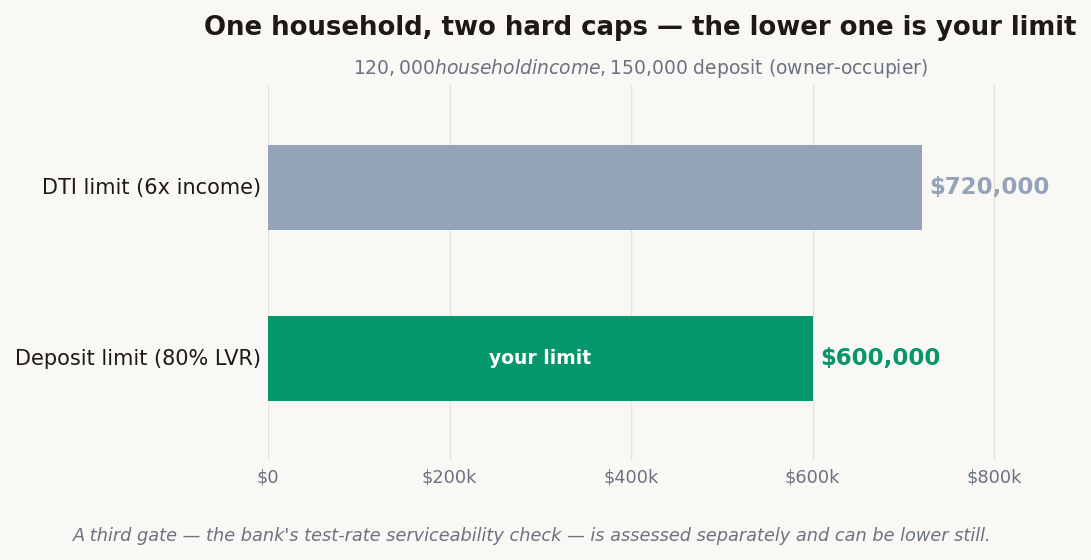
How much you can borrow for a mortgage in New Zealand is set by the lowest of three limits, not one. The Reserve Bank caps most owner-occupier lending at six times gross household income, your deposit sets a loan-to-value ceiling, and your bank runs its own serviceability test at an interest rate well above the market rate. On a $120,000 household income the 6x limit is $720,000, but a $150,000 deposit caps the loan at $600,000 under the 80% LVR rule, so $600,000 is the real ceiling. Whichever limit is tightest for your numbers is the one that counts.
What is the DTI limit in New Zealand?
Since 1 July 2024 the Reserve Bank has capped debt-to-income lending: owner-occupiers at six times gross annual household income, investors at seven. Banks keep a 20% speed limit, so a small share of new lending can go above the cap for the strongest applicants, but most people should treat 6x as the ceiling. On income alone that means about $480,000 at $80,000 of income, $600,000 at $100,000, $720,000 at $120,000, and $900,000 at $150,000. The ratio counts all your debt, so a car loan, a student loan balance, and even unused credit-card limits are added in and pull the figure down. New builds are exempt from the DTI rule.
How big a deposit do you need (the LVR rule)?
Loan-to-value restrictions set the minimum deposit. Owner-occupiers generally need 20%, which is an 80% LVR, and a useful shortcut is that at 80% your loan is about four times your deposit. So a $150,000 deposit supports a $600,000 loan on a $750,000 home. Investors usually need 30% for an existing property, and new builds are exempt. First-home buyers who cannot reach 20% may qualify for a 5% deposit through the Kāinga Ora First Home Loan, within income caps, though a low-equity premium applies. The Reserve Bank last eased the LVR settings on 1 December 2025.
What is the bank's serviceability test?
On top of the Reserve Bank rules, every bank checks that you could still afford the repayments if rates rose. It tests your application at a rate well above the market rate and confirms you have enough income left after living costs. The gap is large: on a $600,000 loan over 30 years the repayment is about $3,792 a month at 6.5%, but a bank testing at around 8.5% wants to see you could handle about $4,613 a month. For many buyers, especially at lower price points, this test is the binding limit rather than the DTI or deposit rules.
Which limit applies to you?
Work out all three and take the smallest. For the household above, the DTI cap is $720,000, the deposit caps the loan at $600,000, and the serviceability test sits separately on top, so the offer lands at $600,000 or below. Add $30,000 of other debt and the DTI room alone falls to $690,000. The borrowing power calculator works through the same three limits with your figures so you can see which one binds.
How to increase how much you can borrow
A larger deposit lifts the LVR ceiling and can move you off low-equity pricing. Clearing consumer debt and lowering credit-card limits improves both the DTI ratio and the serviceability test, often faster than people expect. A longer term or a lower rate eases serviceability by cutting the assessed repayment. Buying a new build sidesteps both the DTI and LVR rules, leaving serviceability as the main hurdle. Model the trade-offs in the LVR calculator and the mortgage calculator before you commit.
A note on the figures
The DTI multiples and the 80% LVR rule are Reserve Bank settings current in mid-2026 (DTI since July 2024, LVR last eased December 2025). The serviceability figures use a $600,000 loan over 30 years at illustrative market and test rates; each bank sets its own test rate and living-cost assumptions, so treat them as a guide. See the Reserve Bank for the current rules and confirm your own numbers with a bank or licensed adviser.