Offset Mortgages Explained: How They Actually Save You Interest
Published 26 July 2026
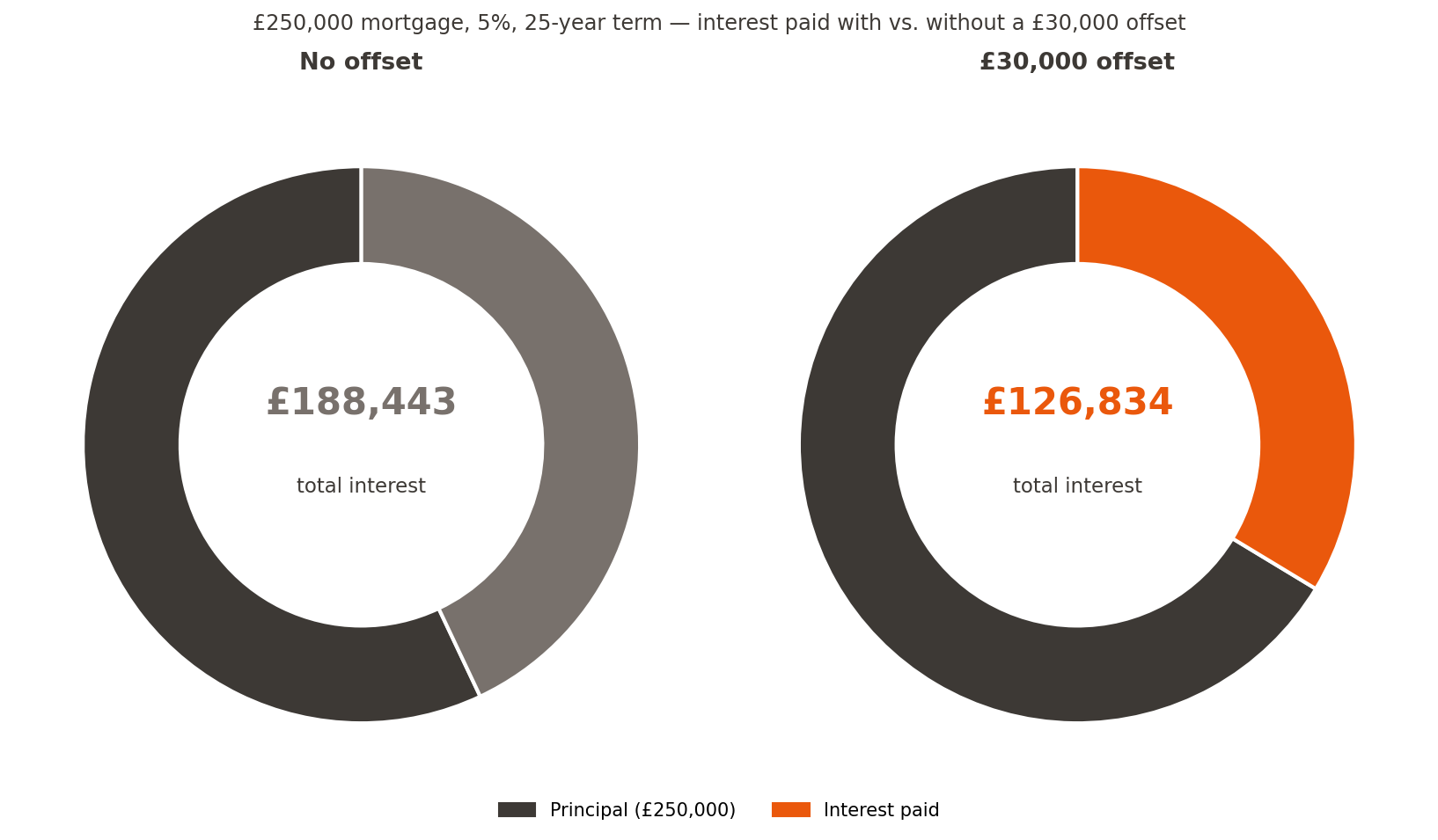
An offset mortgage links a savings account to your mortgage, and instead of paying you interest on the savings, the lender simply charges you mortgage interest on a smaller number: your mortgage balance minus whatever sits in the linked account. Your savings never touch the mortgage balance directly. They just sit there, quietly reducing the amount you're charged interest on, for as long as they stay in the account.
How the offset actually works
Say you have a £250,000 mortgage and £30,000 in a linked savings account. Instead of being charged interest on £250,000, you're charged interest on £220,000 (£250,000 minus the £30,000 offset). The £30,000 itself is still yours, accessible, and untouched. It's simply not earning its own separate interest anymore; its job is to shrink the number the mortgage interest gets calculated on.
The worked example
Take a £250,000 mortgage at 5%, on a standard 25-year repayment schedule, with £30,000 sitting permanently in a linked offset account:
- Standard monthly payment (no offset): £1,461.48, calculated on the full £250,000.
- First month's interest, no offset: £1,041.67.
- First month's interest, with £30,000 offset: £916.67, a saving of £125 in that first month alone.
If the borrower keeps making the same £1,461.48 monthly payment throughout (rather than reducing it to reflect the lower interest charge), the extra amount that would have gone to interest goes to principal instead. The mortgage clears in 258 months (21.5 years) instead of the full 300 months (25 years), a full 3.5 years early. Total interest paid over the life of the loan drops from £188,443 with no offset to £126,834 with the £30,000 offset in place, a saving of roughly £61,600.
Why this beats a normal savings account for many borrowers
The £30,000 in the example above isn't earning interest in the conventional sense, but the interest it's saving you is, in effect, tax-free, because it's not counted as savings income at all. Compare that to keeping the £30,000 in an ordinary savings account instead: for the 2026/27 tax year, basic-rate taxpayers can earn £1,000 of savings interest tax-free (the Personal Savings Allowance), higher-rate taxpayers £500, and additional-rate taxpayers get no allowance at all. Interest above that threshold is taxed at your marginal income tax rate.
For a higher-rate taxpayer with meaningful savings, an offset account effectively delivers a return equivalent to your mortgage rate, tax-free, on however much you keep offset, which frequently beats what an equivalent taxed savings account would net after tax, particularly once your savings interest exceeds your Personal Savings Allowance.
The trade-offs, honestly
Offset mortgages aren't free of downsides:
- The rate itself is often slightly higher than an equivalent non-offset mortgage from the same lender, so the offset benefit needs to be large enough (relative to your typical linked-account balance) to outweigh that premium.
- The linked savings earn 0% directly. If instant-access savings rates elsewhere are unusually high, the comparison gets closer, and it's worth running the actual numbers rather than assuming offset always wins.
- You need meaningful, fairly stable savings for it to matter. An offset account with £2,000 in it, against a £250,000 mortgage, barely moves the interest calculation. The benefit scales with how much you keep offset relative to your mortgage balance.
Offset vs simply overpaying
A related but different option is making direct overpayments on the mortgage instead. Overpayments permanently reduce the mortgage balance and can't easily be pulled back out if you need the cash unexpectedly (some lenders allow limited penalty-free overpayments and some don't allow withdrawal at all). An offset account, by contrast, keeps your money fully accessible: withdraw from the linked account and your effective offset (and the interest saving) simply drops accordingly, with no penalty. If you value flexibility and might need access to the cash, offset generally wins over overpaying. If you're confident you won't need the money and your lender doesn't offer offset, overpaying achieves a broadly similar interest-reduction effect.
Where offset mortgages are available
Offset products are well established in the UK and Australia (where they're usually called offset accounts) and appear in some other markets, but they're not universal; not every lender offers them, and product availability varies by country and even by lender within a country. If you're specifically interested in an offset structure, confirm which lenders in your market currently offer it before assuming it's an option.
Run the numbers on your own balance
The size of the benefit scales directly with how much you keep offset and how long you keep it there. Before assuming an offset mortgage is worth the (often modest) rate premium, calculate what your own typical linked-account balance would actually save you in interest, and weigh that against what you'd earn keeping the same money in a competitive savings account after tax.