What a Mortgage Guarantor Is Signing Up For
Published

Two arrangements get called a guarantor mortgage, and they ask very different things of the person helping. Under a traditional guarantee, the helper is a third-party security provider who pays only if a payment is missed. Under a joint borrower sole proprietor mortgage, they are a borrower on the contract from the first payment, jointly and severally liable for the whole debt whether anything has gone wrong or not.
The second is now the more common structure, and the difference is worth understanding before anyone signs.
What each arrangement commits the helper to
| Traditional guarantee | Joint borrower, sole proprietor | |
|---|---|---|
| When liable | Only after a missed payment | From the first payment |
| On the deeds | No | No |
| Own home or savings as security | Often | No |
| Independent legal advice | Sometimes | Required, every case |
| Boosts what you can borrow | Not directly | Yes, their income counts |
Joint and several liability is the phrase that matters. It means the lender can pursue the helper for the entire balance, not a share of it, and does not have to exhaust the borrower first.
The deeds decision, and what it costs
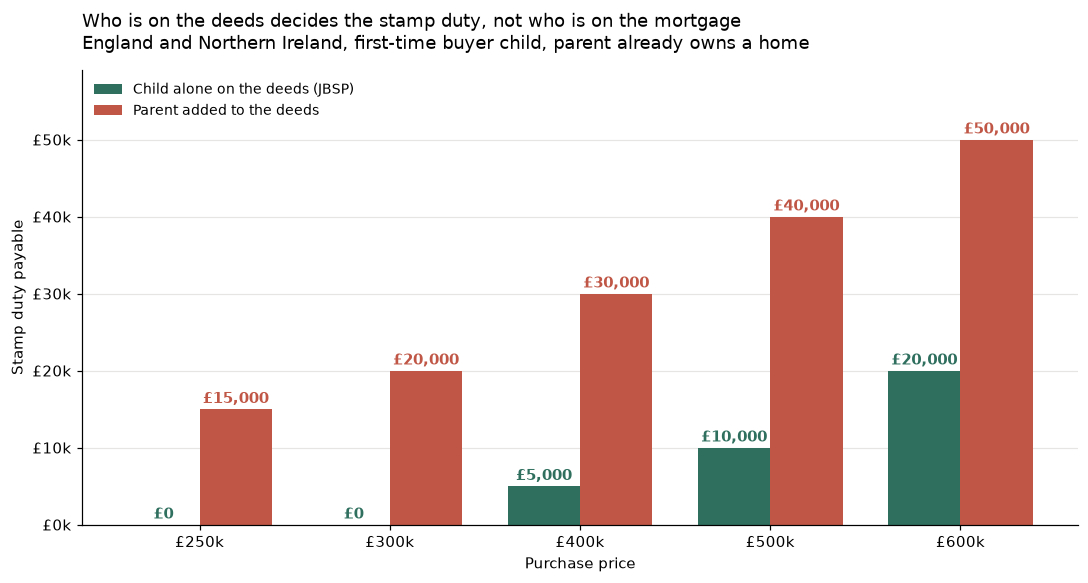
Stamp duty is assessed on who owns the property, not who is named on the mortgage. That single rule is why the structure matters more than most families realise. If a parent who already owns a home joins the deeds, the purchase becomes an additional property for them, the 5 per cent surcharge applies to the whole price, and the first-time buyer relief is lost because relief requires every buyer on the title to be a first-time buyer.
| Price | Child alone on the deeds | Parent added to the deeds | Cost of the decision |
|---|---|---|---|
| £250,000 | £0 | £15,000 | £15,000 |
| £300,000 | £0 | £20,000 | £20,000 |
| £400,000 | £5,000 | £30,000 | £25,000 |
| £500,000 | £10,000 | £40,000 | £30,000 |
| £600,000 | £20,000 | £50,000 | £30,000 |
A note on figures you may see elsewhere. Several widely-read guides still quote a 3 per cent surcharge and first-time buyer relief up to £425,000. Both are out of date: the surcharge rose to 5 per cent on 31 October 2024, and the temporary £425,000 relief threshold ended on 31 March 2025, returning to £300,000. Figures built on the old rates understate the cost of the deeds decision by two percentage points of the entire purchase price. The table above uses the current bands.
One trap worth naming. Keeping the helper off the title does not work if they are given a beneficial interest behind it. For stamp duty the purchaser is whoever the property is held for, so a Declaration of Trust granting a parent an underlying share brings them back into the charge even though their name is not on the register. If a helper is contributing capital and wants that protected, take advice before signing anything, because the protection and the tax position pull in opposite directions.
What the help is worth on the borrowing side
Income multiples are a blunt instrument, but they show the shape. At 4.5 times combined income:
| Borrower income | Alone | Plus £30,000 helper | Plus £50,000 helper |
|---|---|---|---|
| £28,000 | £126,000 | £261,000 | £351,000 |
| £35,000 | £157,500 | £292,500 | £382,500 |
| £45,000 | £202,500 | £337,500 | £427,500 |
A helper on £30,000 adds roughly £135,000 of capacity at every income level, because the multiple applies to their income too. The catch is that their commitments come with them: a helper with a mortgage of their own, car finance and credit balances contributes far less than their salary suggests, and some lenders cap the term at their retirement age rather than the borrower's.
What the help is worth in years
The income boost is easier to judge once it is converted into the thing it replaces: time spent saving. A bigger deposit raises buying power pound for pound, so the question is how long you would need to save to reach the same position alone.
| Helper's income | Buying power added | Saving £300/mo | Saving £500/mo | Saving £800/mo |
|---|---|---|---|---|
| £25,000 | £112,500 | 31.2 years | 18.8 years | 11.7 years |
| £30,000 | £135,000 | 37.5 years | 22.5 years | 14.1 years |
| £40,000 | £180,000 | 50.0 years | 30.0 years | 18.8 years |
| £50,000 | £225,000 | 62.5 years | 37.5 years | 23.4 years |
A parent earning £30,000 who joins the mortgage does roughly what 22 and a half years of saving £500 a month would do. That is the scale of what is being asked for, and it explains why families reach for these products rather than waiting.
The springboard version, and its real price
Savings-backed products work differently again. A helper deposits around 10 per cent of the purchase price into a linked account for a fixed period, commonly three to five years of clean payments, after which it is returned. Nothing is spent, so the cost is what the money could have earned elsewhere.
On a £300,000 purchase that is £30,000 locked away. Over five years the forgone growth is about £4,778 at 3 per cent, or £7,385 at 4.5 per cent, before tax. Worth knowing, and considerably cheaper than the £20,000 stamp duty bill that comes with joining the deeds instead.
What the helper is exposed to each month
The abstract commitment becomes concrete when you price the payment. A £240,000 mortgage at 4.5 per cent over 25 years costs £1,334.00 a month, or £16,008 a year. On £300,000 it is £1,667.50 a month and £20,010 a year. That is the sum a guarantor may have to find, on top of their own housing costs, with no ownership of the property behind it.
It also affects their own borrowing. A guarantee is a declarable financial commitment, so it reduces what the helper can borrow themselves, which matters if they plan to move or remortgage during the term.
How the arrangement ends
Springboard products release automatically after the agreed period. A joint borrower arrangement usually ends when the borrower remortgages in their sole name, which requires passing affordability alone, so it is worth modelling that date rather than assuming it arrives. Open-ended guarantees have no automatic end at all, and if a guarantor dies during the term the lender may ask for a replacement. The remortgage that ends a joint borrower arrangement is also the point at which the stamp duty position is settled for good.
A note on the figures
Stamp duty is computed from the GOV.UK bands for England and Northern Ireland: 0 per cent to £125,000, 2 per cent to £250,000 and 5 per cent to £925,000. An additional property adds 5 percentage points to every band. First-time buyer relief gives 0 per cent to £300,000 and 5 per cent to £500,000, with no relief above that. The model reproduces both worked examples published by GOV.UK exactly. Borrowing figures use a flat 4.5 times multiple to show the shape of the effect; real lenders use affordability models with a stress rate, not a multiple. Repayments assume a 25-year capital and interest term. Scotland and Wales have separate systems. Check your own position in the stamp duty calculator.