What Landlord Certificates Cost
Published

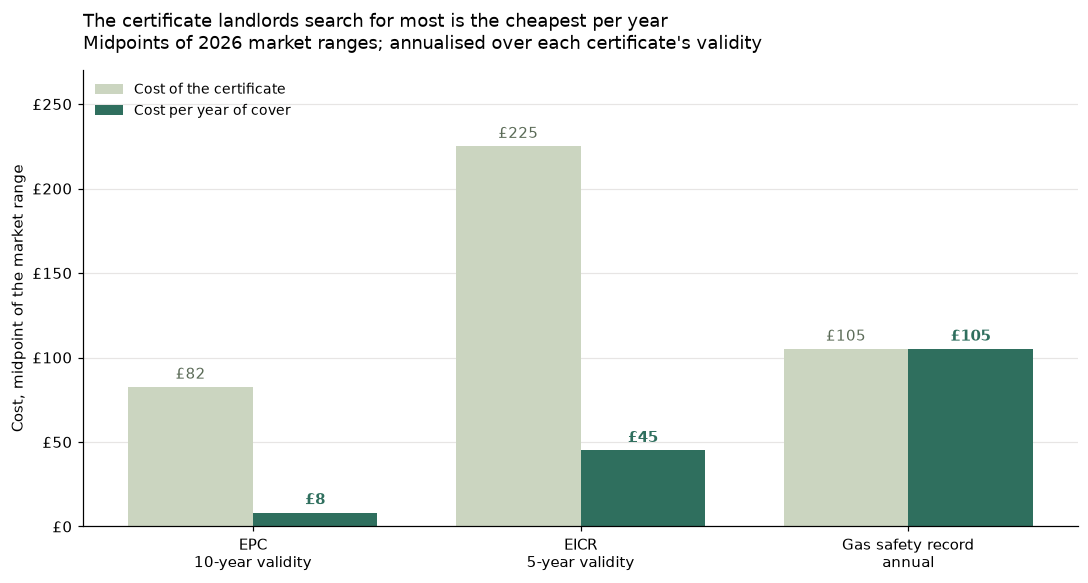
Search for what a certificate costs and you get a single price for a single document. That is not how the bill arrives. An EPC lasts ten years, an EICR five, and a gas safety record one, so the certificate people ask about most is the cheapest of the three once you spread it over the years it covers.
What each one costs, and what it costs per year
There is no government-set price for any of these. The ranges below come from 2026 provider and trade surveys, and they vary by property size, number of appliances and region, with London and the South East usually around 15 to 30 per cent higher.
| Certificate | Typical cost | Valid for | Cost per year |
|---|---|---|---|
| EPC | £45 to £120 | 10 years | £5 to £12 |
| EICR | £100 to £350 | 5 years | £20 to £70 |
| Gas safety record | £60 to £150 | 1 year | £60 to £150 |
| Total | — | — | £85 to £232 |
The last column reorders the priorities. The EPC dominates the search volume and costs £5 to £12 a year. The gas safety record attracts far less attention and costs more than everything else combined, every year, because it never stops needing renewal.
The five-year picture for one property
Over a five-year cycle you pay for one EPC, one EICR and five gas checks. That is roughly £423 at the low end of every range and £1,160 at the high end. The five annual gas certificates alone account for £300 to £750 of it.
Remedial work is separate and is where the real variance sits. Minor electrical fixes are usually around £50 to £200, and a rewire runs into thousands. An inspection is a known cost; what it finds is not.
What it does to your yield
Compliance is a real cost but a small one against gross yield, and it is worth seeing the actual size rather than guessing at it.
| Price | Rent | Gross yield | Yield after compliance |
|---|---|---|---|
| £180,000 | £850/mo | 5.67% | 5.54% to 5.62% |
| £250,000 | £1,100/mo | 5.28% | 5.19% to 5.25% |
| £350,000 | £1,450/mo | 4.97% | 4.91% to 4.95% |
| £500,000 | £1,900/mo | 4.56% | 4.51% to 4.54% |
The drag is between 0.02 and 0.13 percentage points. Compliance is not what breaks a buy-to-let. But the burden is uneven: at £850 a month the annual bill is 10 to 27 per cent of one month's rent, while at £1,900 it is 4 to 12 per cent. Cheaper properties carry the cost least comfortably, because the certificates cost much the same regardless of what the property earns.
Three ways landlords overpay
Booking separately is the common one. Arranging the gas check, EICR and EPC as a single visit is reported to save £20 to £40, which is a quarter of the annualised total at the low end.
Leaving it late is the expensive one. Emergency same-day inspections carry a premium, and you can renew a gas safety record up to two months early without losing the original expiry date, so there is no reason to run to the deadline.
Chasing the cheapest quote is the false economy. A very low price can mean a thin inspection, and on an EPC a rushed assessment may miss improvements that would have lifted the rating. National providers are usually around at £110 to £130 for a gas check where an independent Gas Safe engineer is cheaper.
The obligations behind the costs
A landlord gas safety record is required annually under the Gas Safety (Installation and Use) Regulations 1998. An EICR is required every five years for a rental in England, or at a change of tenancy, with penalties for non-compliance reported at up to £30,000. An EPC must exist before a property is marketed for sale or rent and lasts ten years.
Compliance costs are normally an allowable expense against rental income, though how they are treated depends on whether the work is a repair or an improvement. That is a question for your accountant rather than a cost guide. They also sit inside the running costs that separate gross from net yield, which rental yield and the buy-to-let stress test works through.
A note on the figures
Unlike stamp duty or mortgage insurance, none of these prices is set by government, so the ranges here are drawn from 2026 provider and trade cost surveys and the sources genuinely disagree with each other. Annualised figures divide the cost range by the validity period. Yield figures are annual rent divided by purchase price, then less the annualised compliance range, and exclude mortgage interest, management, insurance, voids and remedial work. Put your own numbers into the rental yield calculator rather than relying on an illustration.