What a Longer Mortgage Term Really Costs You
Published

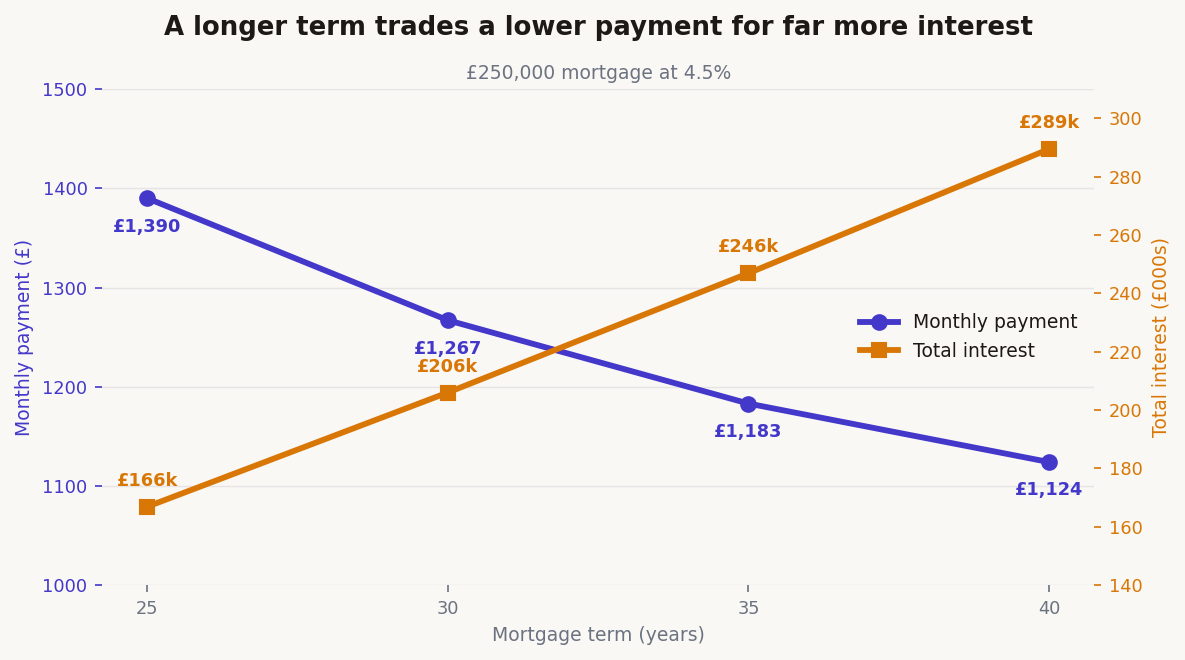
Your mortgage term length is the number of years you take to repay the loan, and it pulls two numbers in opposite directions. A longer term lowers the monthly payment but raises the total interest you pay, often by tens of thousands of pounds. On a £250,000 mortgage at 4.5%, moving from a 25-year term to 35 years drops the monthly payment by about £206, from £1,390 to £1,183, and the trade is roughly £80,000 of extra interest over the life of the loan. The 25-year term was the long-standing UK default; 30, 35, and even 40-year terms are now common, especially among first-time buyers stretching to make the monthly figure work.
How does the mortgage term length change your monthly payment?
A repayment mortgage clears both the interest and the capital by the end of the term. Spread the same debt over more months and each payment is smaller, because a larger share of the balance is pushed into later years. The catch is that interest is charged on the outstanding balance every month, and a longer term keeps that balance higher for longer, so you pay interest across more years. That is why the monthly saving looks modest while the lifetime cost climbs steeply.
How much more interest does a longer term cost?
Take a £250,000 mortgage at a fixed 4.5% and hold the rate steady for the whole term. A 25-year term costs about £1,390 a month and roughly £167,000 in interest. A 30-year term costs about £1,267 a month and roughly £206,000, around £39,000 more interest for £123 a month less. A 35-year term is about £1,183 a month and roughly £247,000, about £80,000 more interest than the 25-year loan. Stretch to 40 years and the payment falls to about £1,124 while the interest reaches roughly £289,000, about £123,000 more than the 25-year term. Each extra five years shaves a little off the payment and adds a lot to the bill.
Why are longer mortgage terms so common now?
Higher house prices and higher rates have pushed monthly payments up, and a longer term is the simplest lever a buyer has to bring them back down. Industry figures show the average first-time-buyer term has stretched from around 25 years two decades ago to past 30 years today, and most mainstream lenders will now run to 40 years. There is a ceiling, though: lenders assess your age and expected retirement, and many want the mortgage repaid by about 70 to 75, so a very long term is not open to everyone.
Can you get the lower payment without the bigger bill?
Often, yes. Take the longer term for the safety of a lower required payment, then overpay toward the shorter-term amount whenever you can. Paying the 25-year figure of about £1,390 a month on a 30-year mortgage clears it in roughly 25 years, so you keep the flexibility of the lower commitment and give up little or no extra interest. This only works cleanly while there are no early repayment charges and the rate is the same, so check your deal first and model it in the overpayment calculator.
How to choose your mortgage term
A good rule is the shortest term you can comfortably afford, since that minimises interest without straining the monthly budget. If a shorter term fails the lender affordability test, a longer one with planned overpayments is a sensible middle path, and monthly against lump-sum overpayments compares the two ways of doing it. Revisit the term at every remortgage, because your income, rate, and goals change. Model a few options in the mortgage calculator, and check what each term does to your borrowing limit in the affordability calculator.
A note on the figures
The figures assume a £250,000 repayment mortgage at a constant 4.5% over the full term, rounded for clarity. Real rates change at each deal, so treat these as a like-for-like comparison of term length rather than a forecast. Bank Rate was 3.75% in mid-2026. For the wider picture see MoneyHelper and the Bank of England, and confirm your own numbers with a regulated broker.