Using KiwiSaver for Your First Home Deposit
Published

After three years in KiwiSaver you can withdraw almost your whole balance towards a first home, leaving $1,000 behind. That is the part most people know. What has changed is everything around it: the First Home Grant closed in May 2024, so the withdrawal and the Kainga Ora First Home Loan are now the only two levers, and a surprising number of guides still tell buyers otherwise.
What the withdrawal gives you
You can take your own contributions, your employer's contributions and the investment returns on both. The only money that has to stay is $1,000. So the arithmetic is simple, and the balance you see on your provider's app is almost exactly what reaches your solicitor.
| KiwiSaver balance | Available for the deposit |
|---|---|
| $5,000 | $4,000 |
| $15,000 | $14,000 |
| $25,000 | $24,000 |
| $40,000 | $39,000 |
| $60,000 | $59,000 |
Two practical points matter more than the numbers. The three-year clock runs from your first contribution rather than from your current provider, so changing schemes in the past does not set you back. And the funds are paid into your solicitor's trust account, not to you, which is why providers ask for ten to fifteen working days before settlement.
The First Home Grant is gone
Kainga Ora stopped accepting applications at 1pm on 22 May 2024, and no replacement has been introduced. The grant had been worth up to $5,000 per person on an existing home and up to $10,000 on a new build, so a couple could reach $20,000.
This matters because the misinformation is still circulating. Guides published during 2026 continue to describe the grant as available, quote those figures, and advise readers to apply before signing a sale and purchase agreement. If you have been counting on that money, it is not there, and a deposit plan built around it will come up short by exactly the amount you expected to receive.
What deposit you reach
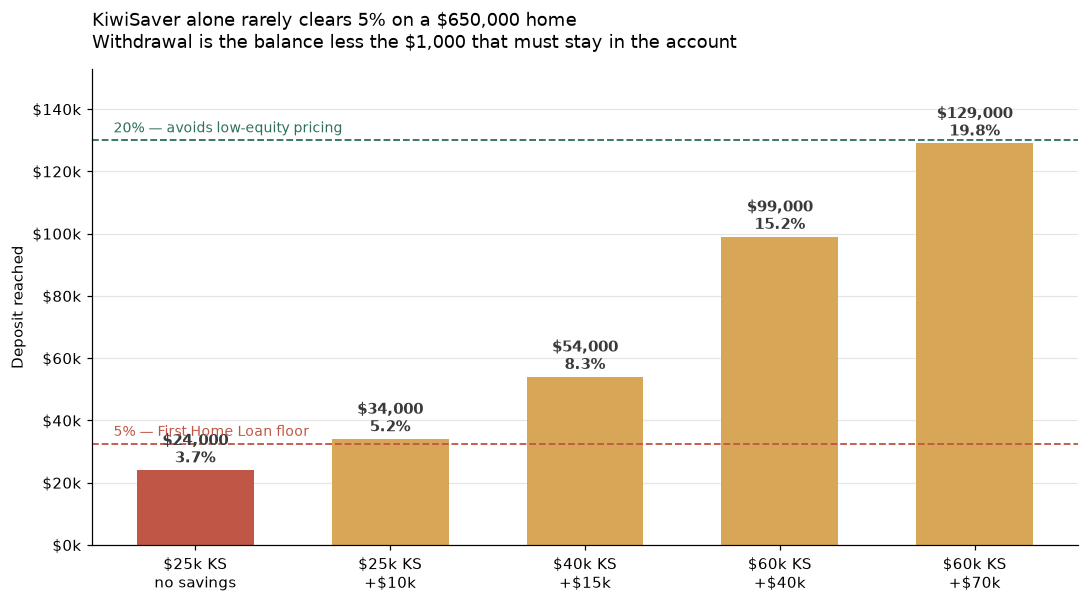
On a $650,000 home, here is what different combinations produce. The percentage is what decides your options, because 5 per cent unlocks the First Home Loan and 20 per cent avoids the low-equity pricing most banks apply.
| KiwiSaver | Other savings | Deposit | As a share of price | Short of 20% by |
|---|---|---|---|---|
| $25,000 | nil | $24,000 | 3.7% | $106,000 |
| $25,000 | $10,000 | $34,000 | 5.2% | $96,000 |
| $40,000 | $15,000 | $54,000 | 8.3% | $76,000 |
| $60,000 | $40,000 | $99,000 | 15.2% | $31,000 |
| $60,000 | $70,000 | $129,000 | 19.8% | $1,000 |
Look at the first row. A $25,000 balance on its own is 3.7 per cent of this price, which does not even reach the 5 per cent floor. KiwiSaver alone is rarely enough for a single buyer at typical New Zealand prices, and the gap to 20 per cent stays large until savings do most of the work.
Two buyers, two minimums
Buying with a partner doubles the withdrawal, and both of you leave $1,000 behind. Balances of $30,000 each give you $58,000 rather than $60,000, and with $10,000 of savings that is $68,000, or 10.5 per cent of a $650,000 house. At $45,000 each you reach $88,000 from KiwiSaver alone, and $108,000 with $20,000 of savings, which is 16.6 per cent.
The 5 per cent route, and why it is a floor rather than a target
The Kainga Ora First Home Loan lets eligible buyers purchase with a 5 per cent deposit instead of the 20 per cent most banks want. Kainga Ora underwrites the loan, so the lender takes less risk and prices it normally. Your KiwiSaver withdrawal can make up the entire 5 per cent.
| Price | 5% deposit | 20% deposit | Difference |
|---|---|---|---|
| $500,000 | $25,000 | $100,000 | $75,000 |
| $650,000 | $32,500 | $130,000 | $97,500 |
| $800,000 | $40,000 | $160,000 | $120,000 |
| $1,000,000 | $50,000 | $200,000 | $150,000 |
The saving in years is real, and so is the cost. On the $650,000 house, a 5 per cent deposit leaves a $617,500 mortgage where 20 per cent leaves $520,000, a difference of $97,500 that you pay interest on for the whole term. The 5 per cent is the minimum you need, not the deposit you should aim for. Income and property criteria apply and change periodically, so check the current rules with Kainga Ora rather than a summary.
Three rules that catch people out
You cannot withdraw while you are still house hunting. The application needs a signed sale and purchase agreement, so the money only moves once you have a property under contract. That is why providers ask for ten to fifteen working days and why brokers suggest building six to eight weeks of comfort into your conditions.
Funds transferred into KiwiSaver from an Australian complying superannuation scheme cannot be used for a first home. If you have worked in Australia and moved your super across, part of the balance on your statement is not available for this purpose, and the shortfall usually only becomes clear when your solicitor confirms the figure.
The withdrawal is once only. Having used it, you keep contributing and the account stays open, but a future purchase cannot draw on it again.
Your balance grows faster from April 2026
The default KiwiSaver contribution rate rose from 3 to 3.5 per cent on 1 April 2026, with a further step to 4 per cent scheduled for 1 April 2028. On an $80,000 salary that lifts your own contribution from $2,400 to $2,800 a year, and with employer contributions at the same rate about $800 more lands in the account annually. If you are already contributing above the default, nothing changes for you. What that deposit then lets you borrow is set by three separate limits, covered in how much you can borrow in New Zealand.
A note on the figures
Withdrawal amounts are the balance less the $1,000 that must remain, per the Kainga Ora rules. Deposit percentages are the deposit divided by the purchase price. The 20 per cent benchmark is standard bank practice rather than a statutory rule, and the 5 per cent figure is the Kainga Ora First Home Loan minimum. Investment returns mean your balance at settlement will differ from your balance today, and eligibility for both the withdrawal and the First Home Loan is assessed individually. Check your own position in the KiwiSaver first home calculator.