What Extra Principal Payments Really Save You
Published

An extra principal payment is money you pay on top of your required mortgage payment. It goes straight to the balance rather than to interest, and its effect is larger than most people expect. On a $400,000 loan at 6.5% over 30 years, the required payment is about $2,528 a month and the interest bill over the full term comes to roughly $510,200. Paying an extra $100 a month saves about $63,900 and clears the loan around three years early. Raise that to $500 a month and you save about $205,600 while finishing more than ten years ahead of schedule. What extra principal does not do is reduce your required monthly payment, and that distinction catches people out.
How do extra principal payments work?
Interest on a mortgage is charged on the outstanding balance. So every dollar you knock off the balance early removes all the interest that dollar would have attracted over the remaining years. That is why the timing matters so much. On the very first payment of this loan, about $2,167 goes to interest and only about $362 reduces the balance. So an extra $100 in the first month is doing work that no amount of extra payment in year 28 could match. Your required payment stays the same, the loan simply runs out of balance sooner, and the schedule ends early.
How much will extra principal payments save you?
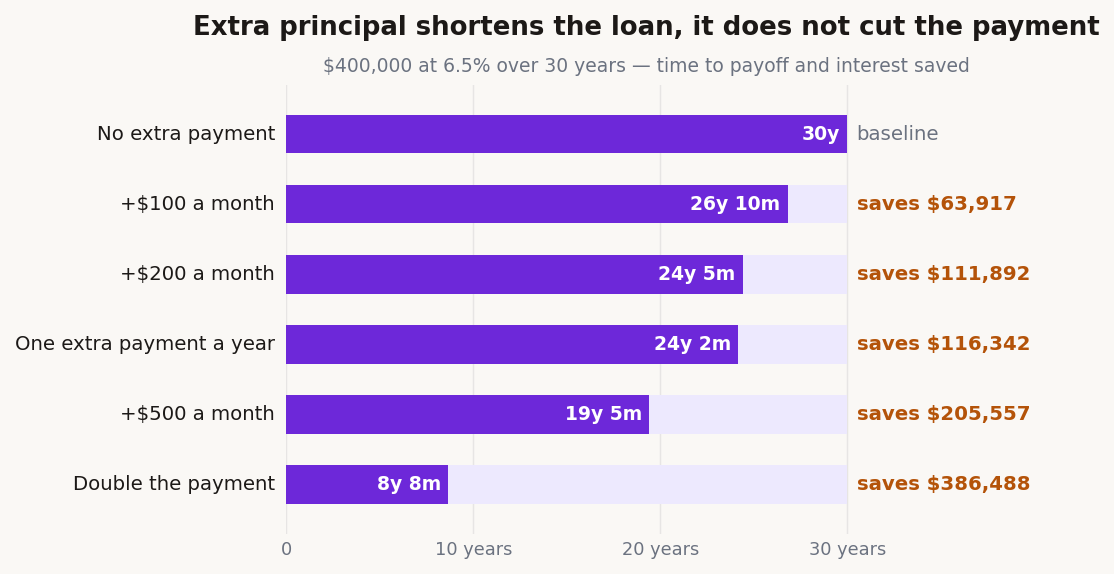
Take the same $400,000 loan at 6.5% over 30 years and hold the rate steady. An extra $100 a month clears it in about 26 years 10 months and saves roughly $63,900 in interest. An extra $200 a month brings it down to about 24 years 5 months and saves about $111,900. An extra $500 a month finishes the loan in about 19 years 5 months and saves about $205,600, which is more than half the original balance. A single extra full payment each year, the approach behind biweekly schedules, lands close to the $200-a-month result: about 24 years 2 months and roughly $116,300 saved. That is because 26 half-payments a year add up to 13 monthly payments rather than 12.
What happens if you double your mortgage payment?
Doubling the payment is the most dramatic version of the same mechanism, and the arithmetic is striking. Paying about $5,057 a month instead of $2,528 on this loan clears it in roughly 8 years 8 months rather than 30. It cuts the interest bill from about $510,200 to about $123,700, a saving of around $386,500. The reason the term falls so far is that almost the entire second payment attacks principal. The balance drops quickly, and the interest charged each month shrinks with it. Few households can sustain a doubled payment, but it shows how sensitive the total cost is to how fast the balance comes down.
Do extra payments lower your monthly payment?
No, and this is the point most people get wrong. Your required payment was fixed when the loan was amortised, so paying extra shortens the schedule instead of reducing what you owe each month. You remain contractually obliged to pay the original amount. If a lower monthly payment is what you need, ask your servicer about a recast. It re-amortises the reduced balance over the remaining term and does lower the required payment, usually after a lump sum and for a modest fee. Escrow for taxes and insurance is separate and does not change when you pay extra principal, so your total bill will still move with those costs.
How do you make sure the money reduces principal?
This is the step that wastes people's money without them realising. If you send extra funds without instruction, many servicers record it as a payment made ahead of schedule. That covers your next installment of interest and principal instead of cutting the balance immediately, and the saving is much smaller than it should be. Tell the servicer in writing that the extra amount is a principal-only payment, and use the principal-only field if the payment portal has one. Check the following statement to confirm the balance moved by the full extra amount. Keeping your regular payment unchanged while you do this is what makes the comparison in the mortgage payoff calculator match what happens.
When paying extra is not the best move
Extra principal is not automatically the right call, because the money has other uses that may serve you better. Clearing higher-interest debt such as credit cards almost always beats prepaying a 6.5% mortgage. An employer retirement match is effectively free money you would be giving up. And an emergency fund matters more than a shorter term, because home equity is hard to reach in a crisis. Check your closing disclosure for a prepayment penalty before making a large payment. Federal rules permit one only in the first three years and only on certain loans, capped at 2% of the balance in the first two years and 1% in the third. If your loan-to-value is still above 80%, reaching 20% equity to end mortgage insurance can be the more valuable target. You can check it in the PMI calculator, and the automatic and requested removal points differ, which how PMI is calculated and how long you pay it sets out.
A note on the figures
Every figure here is calculated from standard monthly amortisation on a $400,000 loan at a fixed 6.5% over 30 years. Extra amounts are applied to principal from the first month, and the rate is held constant for the full term. Real results move with your rate, balance, start date, and how your servicer posts payments, and the numbers exclude taxes, insurance, and fees. For the rules on prepayment penalties see the Consumer Financial Protection Bureau, and confirm your own position with your servicer or a licensed loan officer.