How PMI Is Calculated, and How Long You Pay It
Published

PMI is calculated as an annual percentage of your loan amount, divided by twelve and added to your monthly mortgage payment. The percentage usually falls between 0.3% and 1.5% a year, and it is set mainly by your credit score and your loan-to-value ratio. On a $400,000 home bought with 10% down, giving a $360,000 loan, a 0.65% rate works out at about $195 a month. The figure that surprises people is not the monthly premium but the total. How long you pay it depends almost entirely on your down payment. The difference between putting down 5% and 15% is about $15,000 of premiums over the life of the loan.
How is PMI calculated on a conventional loan?
The arithmetic is straightforward once you know your rate. Multiply the loan amount by the annual PMI rate, then divide by twelve. So a $360,000 loan at 0.65% gives $2,340 a year, or about $195 a month, charged on top of principal, interest, taxes, and insurance. Mortgage insurers price that rate from two things above all: your credit score and your loan-to-value at the point the loan is written. A higher LTV or a lower score both push the rate up. PMI is required on conventional loans when you put down less than 20%, and it protects the lender rather than you. That is why removing it is worth planning for.
What is a typical PMI rate?
The published range of roughly 0.3% to 1.5% a year hides a wide spread in real money. On that same $360,000 loan, 0.3% is about $90 a month while 1.5% is about $450. So the same loan can carry a five-fold difference in premium depending on the borrower. Credit score does most of the work. Industry data puts borrowers at 760 and above near 0.46% a year, about $138 a month here, while scores below 680 frequently pay above 1%, which is more than $300 a month. Raising a score before you apply is one of the few levers that changes the premium rather than merely shortening it.
How long will you pay PMI?
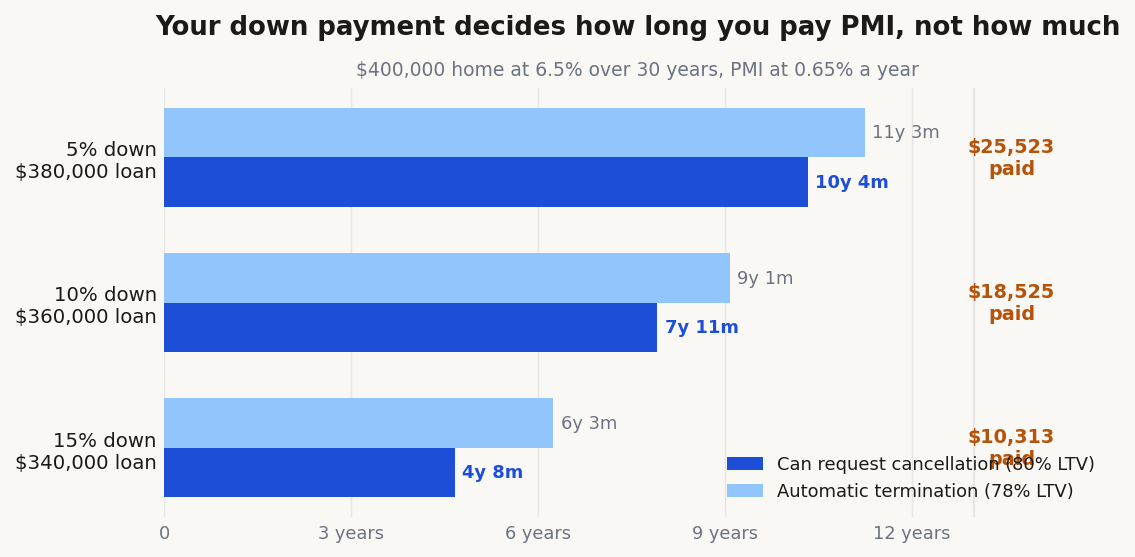
This is where the down payment matters most, and it works through duration rather than rate. On the $400,000 home at 6.5% over 30 years, a 5% down payment reaches the 80% cancellation point after about 10 years 4 months. It costs roughly $25,500 in premiums along the way. Ten per cent down gets there in about 7 years 11 months for roughly $18,500, and 15% down reaches it in about 4 years 8 months for roughly $10,300. The monthly premium barely moves across those three cases, from about $206 to about $184. Yet the total differs by around $15,000 because of how many years it runs.
When does PMI have to end?
Federal law gives you three exits, and they are worth knowing because servicers do not always volunteer them. Under the Homeowners Protection Act you can submit a written request to cancel once the balance reaches 80% of the original value, which is the purchase price or original appraised value, whichever was lower, provided you are current and have a clean recent payment record. Your servicer must then terminate PMI automatically once the balance reaches 78% of that original value on the original amortisation schedule. And if neither has happened, it must end at the midpoint of the loan term. Note that these rights cover conventional loans with borrower-paid PMI; FHA mortgage insurance follows separate rules and often lasts the life of the loan.
How can you get rid of PMI faster?
Extra principal is the most direct route, because the 80% request depends on your actual balance rather than the original schedule. On the $360,000 loan, an extra $100 a month reaches 80% about 18 months sooner and avoids roughly $3,500 of premiums. An extra $200 a month brings it forward about 31 months and avoids roughly $6,000, which you can model in the mortgage payoff calculator, and what extra principal payments really save you works the same arithmetic through on the loan as a whole. A rising local market can also help, since a new appraisal showing more equity may support cancellation, though the lender sets the rules and you usually pay for the appraisal. Refinancing removes PMI once you are below 80%, but only makes sense if the new rate and closing costs justify it on their own.
A note on the figures
The examples assume a $400,000 home financed at a fixed 6.5% over 30 years with PMI charged at 0.65% a year of the original loan amount, and cancellation points calculated from standard monthly amortisation against the original value. Real premiums are set by the mortgage insurer and vary with credit score, loan-to-value, loan type, and coverage, and some servicers recalculate the premium as the balance falls. Your rights under the Act apply to single-family principal residences that closed on or after 29 July 1999, and not to FHA or VA loans. For the detail see the Consumer Financial Protection Bureau, and confirm your own premium and dates with your servicer.